
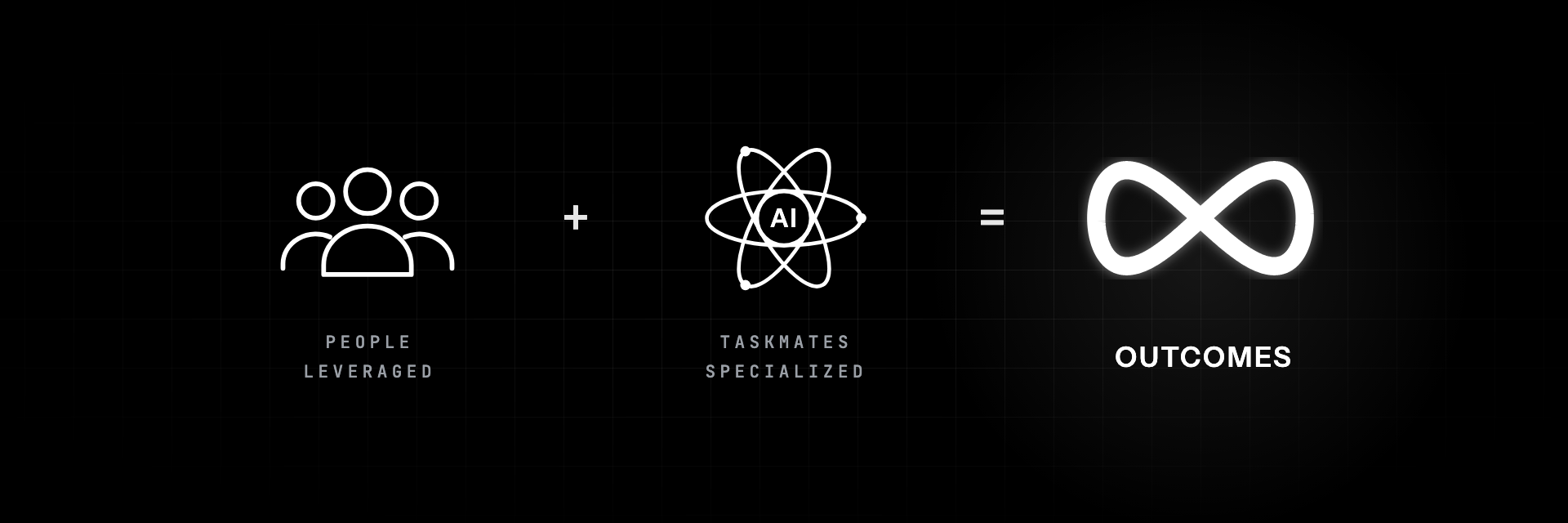
Work has moved twice: from the field to the factory in the Industrial Revolution, then from the factory to the screen in the Digital Revolution.
The third move, the Outcome Revolution, has started.
For the past sixty years, work has meant sitting hunched at a screen, clicking a mouse and copying and pasting. People work until 3am adjusting PowerPoint slides and tweaking made-up numbers in a financial model. We look back at the people who built the pyramids and can’t believe how they worked; one day soon, people will look back at us the same way.
Attain exists to speed the move from the copy-and-paste economy to the outcome-based economy. Jobs are breaking down into tasks, and each task is going to whoever does it best, a human or a taskmate, our word for an agent built for one role.
The biggest lever we have is learning how every role’s work gets done, and the Forward Deployed Agent, or [fda], is the first step.
The Wedge
The Forward Deployed Agent [fda] installs on a team’s computers and learns the work in two weeks. It breaks each role into tasks and hands back a map of what to build first. We then build taskmates for the repeat tasks and teach the team to orchestrate them.
We’re early, and to some, this feels intrusive.
That’s ok, it’s supposed to.
In 2013 Elon said Teslas would drive themselves for 90% of miles within three years. It took thirteen years, and Tesla’s cars have now driven themselves 17 billion miles. Granola launched in May 2024. Recording every meeting felt invasive, and now it’s standard practice.
Tasks are next.
Models keep getting smarter and still fall short on the last mile. Andrej Karpathy calls it the march of nines: a demo that works 90% of the time is only the first nine, and getting to 99%, then to 99.9%, takes the same amount of work each time.
The last mile is where Attain works. Every taskmate we place makes every other taskmate in that role better, so the SDR taskmate at company fifty starts with everything we learned at the first forty-nine. A role we learn once carries to the same role in every industry.
The Copy-and-Paste Economy
Three problems hold work at the screen.
- Unwritten work. Nobody has written down how the work gets done. It lives in people’s habits, like which leads an SDR emails first and what the email says. On our own four-person team the [fda] found 168 hours a month spent carrying information between tools. You can’t automate work you can’t see.
- Reactive tools. Almost every AI product is reactive. It waits to be asked, and a business owner doesn’t know what to ask it. Anthropic backed Ode, a firm that sends engineers inside companies to put its models to work, and nobody funds that if the model deploys itself.
- Old habits. Retraining human behavior has proven to be the most difficult and time-consuming part of adjusting to the new normal of how work “gets” done. You can give a task to a taskmate on Monday and catch yourself doing it by hand on Tuesday.
The [fda] works in the background, so it addresses all three. Its map is the written record of how the work gets done, so a taskmate arrives knowing the role and comes to you with the tasks it can take this week. Then the [fda] teaches the team the new habit of orchestrating taskmates.
That makes Attain a digital labor company. Our taskmates deliver outcomes, role by role.
The Outcome-Based Economy
Every kind of work so far has kept people at the task: in the field, on the factory floor, at the screen. In the outcome-based economy, people own outcomes, and taskmates handle the tasks.
Computers have had three interfaces in about eighty years. First you handed over the whole program, then you gave every step, and now you type what you want each time you want it. The fourth works like a great hire: you name the outcome once, and the tasks are handled, because the taskmate already knows the role.
A business owner will say “I want ten meetings this week,” and the SDR taskmate will handle the lists, the emails and the follow-ups. Then everyone orchestrates a team of taskmates, and a twelve-person business runs with the output of twelve hundred.
Martin Casado said on Invest Like the Best that “the biggest constraint is no longer the tech.” The constraint is our creativity, worn down by thirty years of software that was hard to use.
The future of work is human orchestration.
The Master Plan
- Put a Forward Deployed Agent on every work computer.
- Break down copy and paste 'jobs' into tasks.
- Enable human orchestration of taskmates.
- Usher in the outcome-based economy.
Come build it with us.


