
By the end of August, ReelCV was live. It gave candidates a richer way to show who they were, but it also created a new problem: we had better profiles and no fast way to find the right one.
That is where this story begins.
If you want the first chapter, start with How We Built ReelCV. I am leaving that story exactly where it ends, with the August launch. This is what happened next.
August: Refining the Live Experience
August was the handoff from ReelCV to what we started calling PeopleGPT internally.
ReelCV had already done the hard work of turning a flat CV into a structured, much more human candidate profile. Now we had to make thousands of those profiles useful to a recruiter in the middle of a real search.
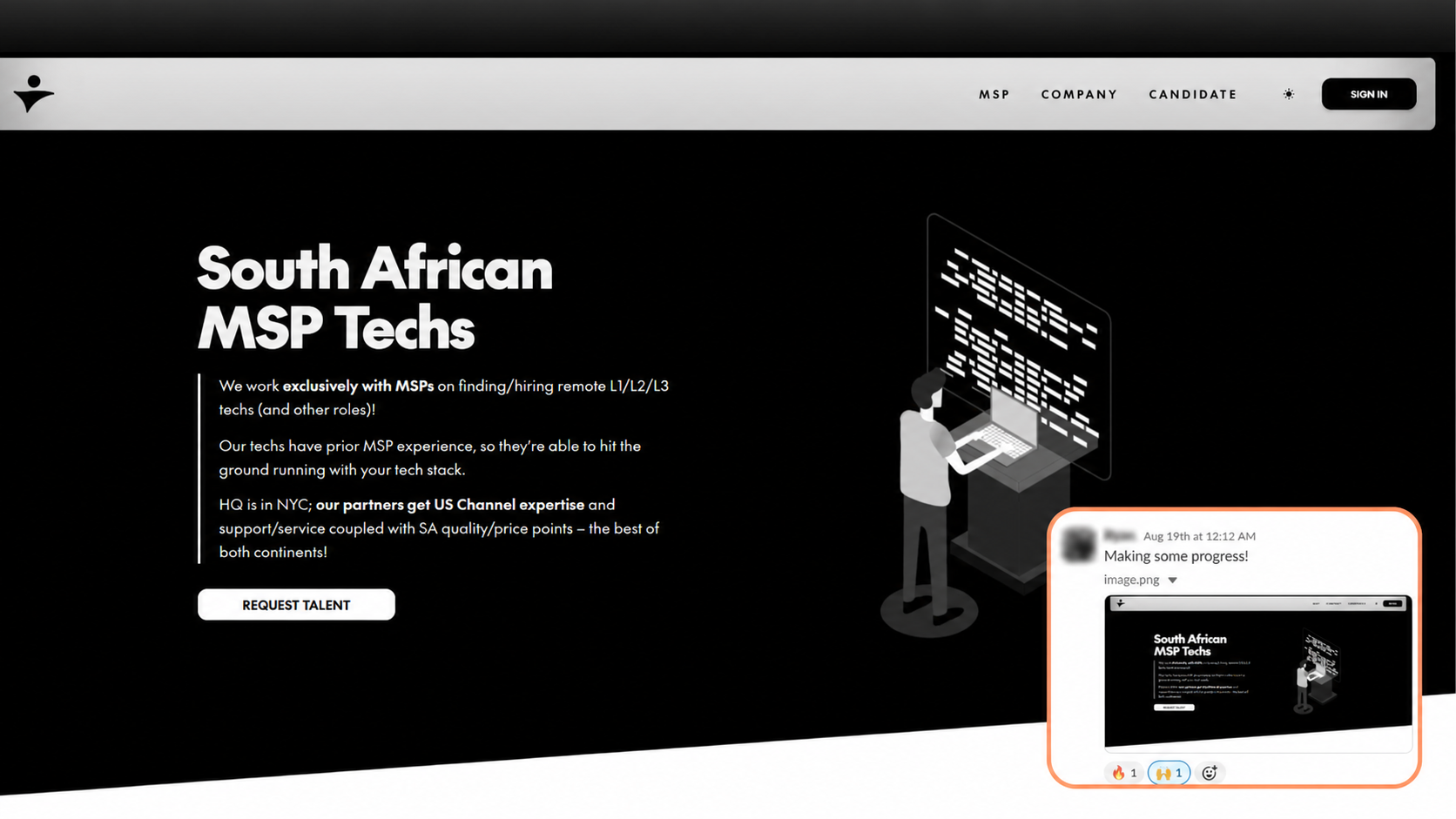
The first step was making the company side of the product feel like one connected experience. Search, job listings, company profiles, recruiter ratings, and hand-picked deliverables all needed to work together.
The bigger idea was simple: recruiters should not have to think like a database. They should be able to describe the person they need in normal language and get back a small number of genuinely useful matches.
September 11: Search Started to Feel Real
On September 11, we walked through the company search experience in a working product.
Instead of stacking rigid filters, a recruiter could type something like, “I am looking for an L1 tech with two years of MSP experience, ideally at a US company,” and let the system interpret the context.
That changed the job of search. It was no longer about returning every profile that matched a keyword. It was about understanding the request, weighing different signals, and surfacing the handful of people a recruiter should actually review.
That was the moment the evolution from ReelCV to AI-powered search became obvious.
The Next Few Weeks: Testing Real Recruiting Workflows
A clean demo is easy. Real recruiting work is messy.
Job descriptions are inconsistent. Clients care about things they forget to write down. Two candidates can have the same title and completely different experience. We needed to know whether the search could handle all of that.
So we started testing it against actual job listings and the kinds of requests our recruiters received every day.
Every test forced us to make the product more practical. The system needed to:
- Understand a request written in plain English.
- Use skills, experience, job history, and context together.
- Return a small group of strong candidates instead of a long list of possibilities.
- Show enough information for a recruiter to understand why each person was included.
This is where the product started learning the difference between a technically correct result and a useful one.
From a Search Box to a Company Experience
A search box by itself is not a product.
Companies still needed a clear place to manage job listings, see the candidates we recommended, and understand what was happening around each search. Our recruiters needed the same information without creating another disconnected workflow.
Over the following weeks, we connected search to company profiles, active roles, recruiter workflows, and hand-picked deliverables. Candidate results became easier to scan, the company side became easier to navigate, and the whole experience started to feel like one system.
That mattered because the value was never the search box. The value was helping a company move from “who are we looking for?” to a credible shortlist without wasting days digging through profiles.
Closing the Feedback Loop
We kept putting the product in front of the people who would actually use it.
Recruiters tested searches, reviewed the candidates PeopleGPT returned, and showed us where the rankings made sense and where they did not. We also looked at how the company experience and our internal admin tools worked together.
The feedback was the product work. Every weak result exposed a missing signal. Every confusing screen showed us where the workflow needed to be simpler. Every useful shortlist gave us more confidence that the idea could work at scale.
Over those next several weeks, PeopleGPT stopped feeling like a feature attached to ReelCV. It became the search and matching layer built on top of everything ReelCV had made possible.
What PeopleGPT Proved
ReelCV made candidate profiles richer and more human. PeopleGPT made thousands of those profiles searchable and actionable.
That was the real evolution. We did not throw ReelCV away and start over. We used the structure, skills, context, and candidate data we had already built, then gave recruiters a faster way to find the right person inside it.
What happened next became Raine. That is a separate story, and I will tell it in its own post.
For now, you can see what we are building at Hirexe.


