November 7, 2026
Self-Driving 'Work'
Driving got solved after years of people teaching the cars. AI at work is on the same road, and it has only just started.
Read more

Driving got solved after years of people teaching the cars. AI at work is on the same road, and it has only just started.
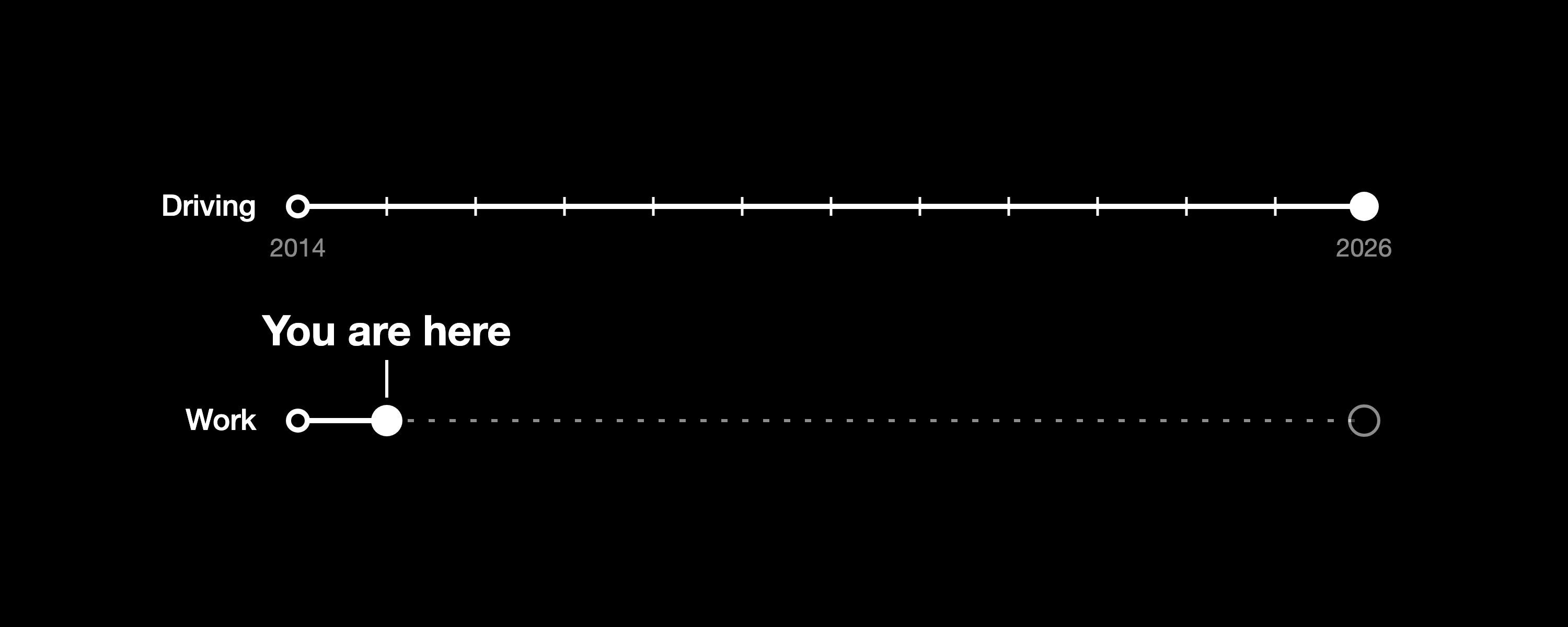
Driving is solved.
'Work' is a completely different story.
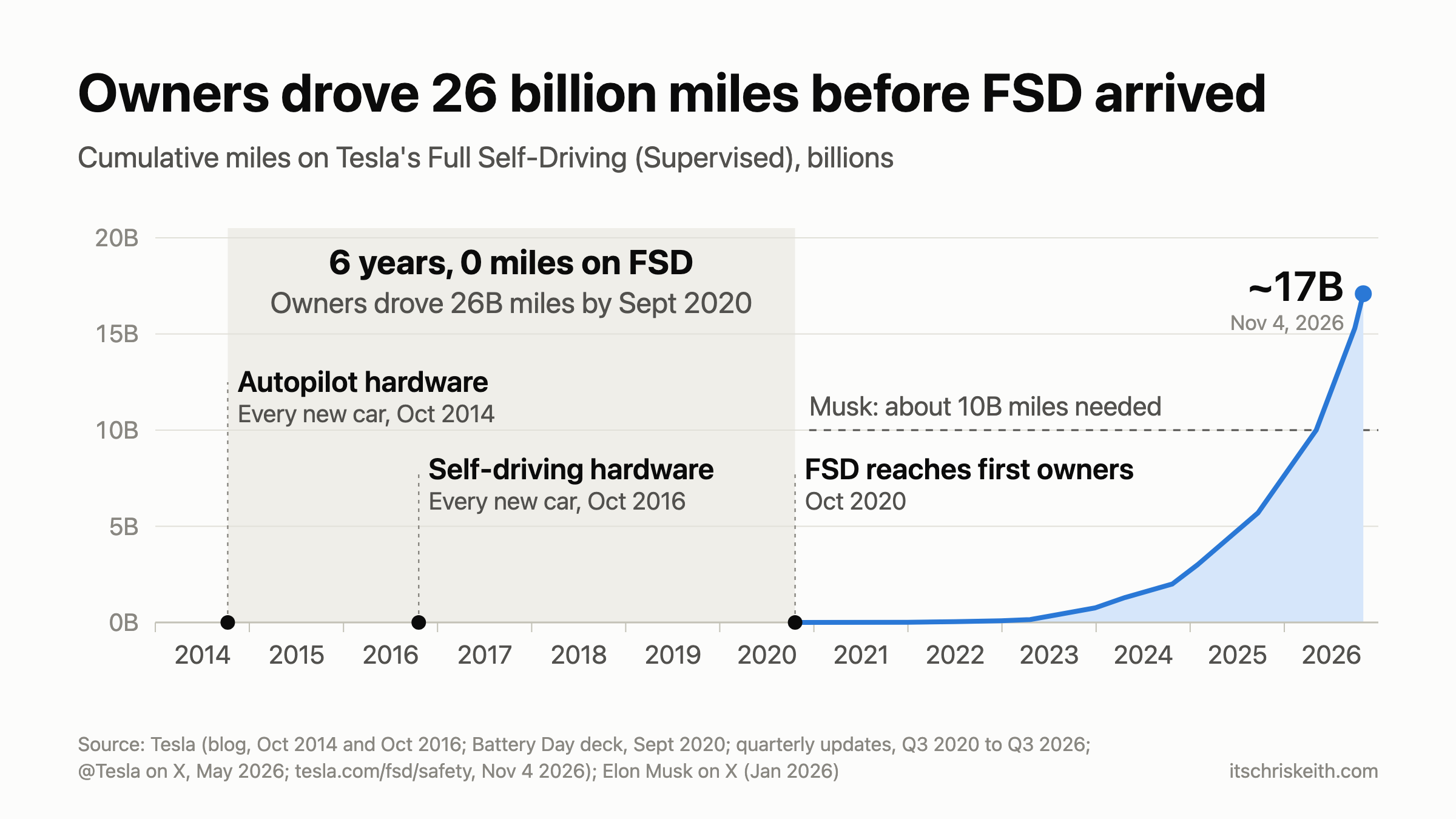
Tesla's cars have driven themselves 17 billion miles. Over Labor Day, a rented Tesla drove me 498 of the 500 miles on a road trip, and it felt like I was a passenger.
Elon Musk first put a date on it in 2013, when he said Teslas would drive "90 per cent of miles" within three years. By 2016 he was calling it "basically a solved problem."
It took thirteen years (ten more than he said), but driving is legit solved.
Owners sat behind the wheel for every one of those miles while the software drove, and every time one of them took over, the car learned where it had gone wrong. Musk puts the bar at roughly 10 billion miles of that before a Tesla can safely drive itself. The fleet passed it this spring, and Tesla still keeps an owner behind the wheel.
Even now, the rules are still catching up. New York law still requires a hand on the wheel, and only about two dozen states let a car drive itself with nobody in the driver's seat.
AI at work is on the same road...
But years behind.
Jobs are breaking down into tasks, and tasks are to work what miles are to driving.
AI has gotten good at three-second tasks and, for the most part, three-minute ones. The newest agents are making real progress on three-hour tasks, and that's where AI still needs work.
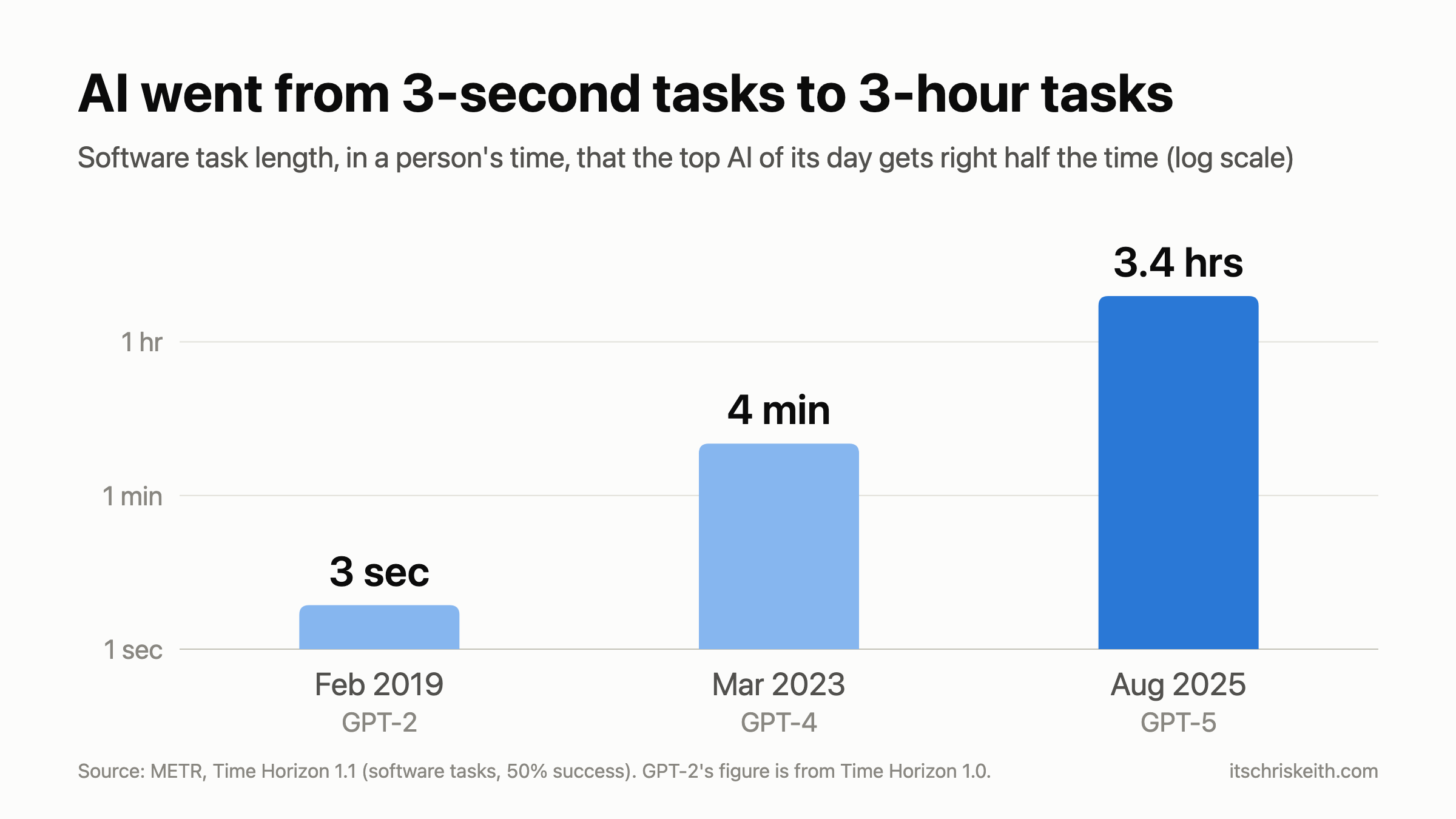
The models haven't driven the miles.
The labs know it, which is why they pay companies like Mercor billions a year to have experts show them how real work gets done. On a long task, the model does the work itself, and when it goes wrong an expert steps in and corrects it, the way a Tesla owner grabs the wheel.
AI at work is still on its learner's permit.
When OSWorld 2.0 tested four top models on real computer workflows, counting only the ones finished start to end, the best completed about one in four tasks that take a person under 45 minutes. Past about three hours, all four scored zero.
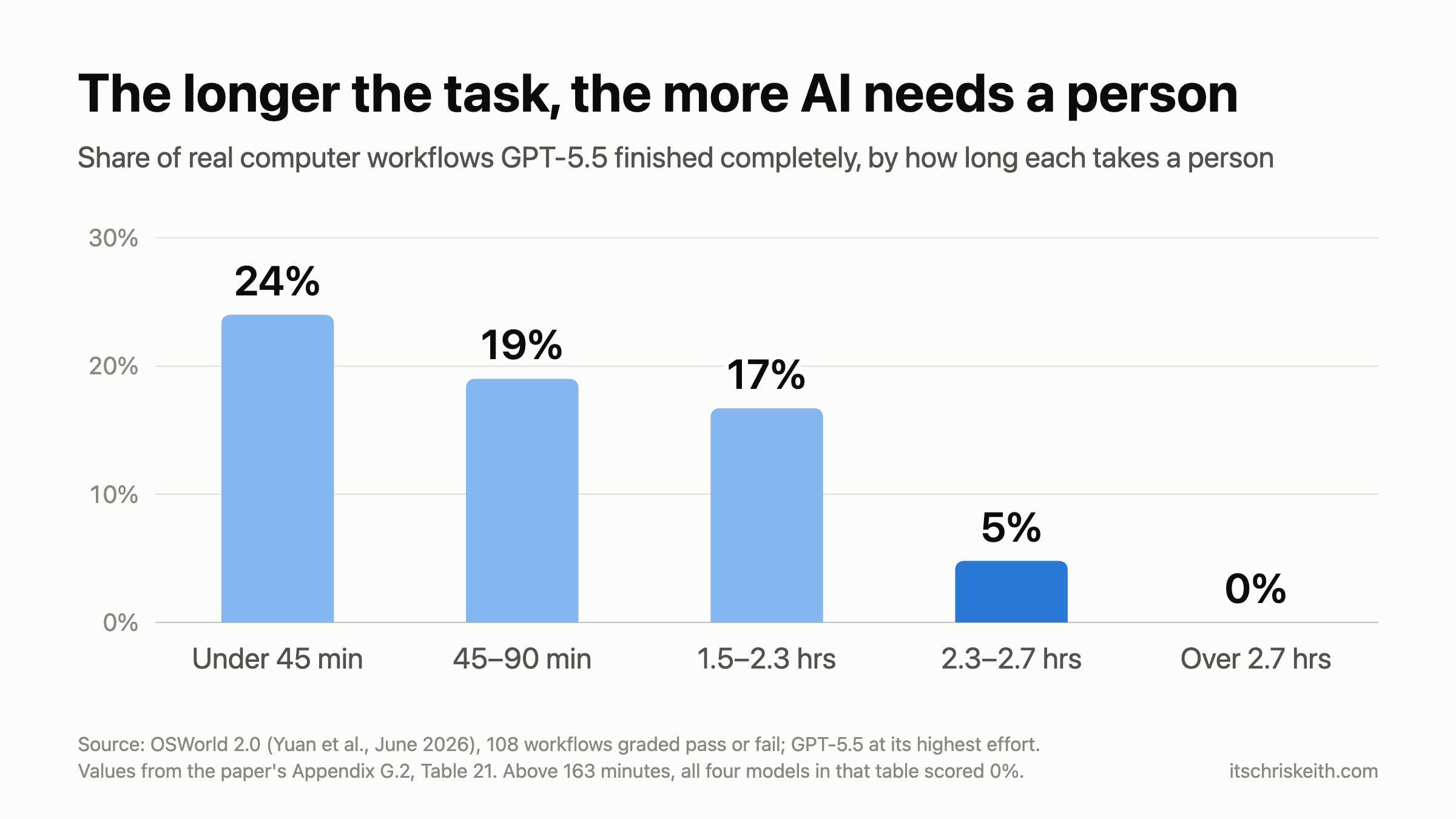
At work, the miles get driven inside real businesses, by the people doing the work every day.
Driving got solved one mile at a time, with people at the wheel the whole way.
'Work' will get there the same way, task by task, taught by the people already doing it.
The new luxury in a car is not having to drive.
At work, it's not having to do the tasks no human should be doing.
Humans don't have to 'drive' anymore -> but we still have to tell the car where to take us to get from point A to point B.
'Work' will be the same.
We won't have to do mundane 'tasks' (driving) -> but we'll still need to provide the final destination.
The best definition of an agent I've found, the OIIL process behind it, and an AI SDR that does what took a team of 15.

What are agents?
Here is the anti-slop canon definition:
Agents = Get Shit Done
That's it. This is the only definition you need.
Agents do shit (mundane, rote, repetitive tasks) no human wants to do.
At AI Ascent in April, Sequoia's Pat Grady (@gradypb) gave agents a working definition. An agent qualifies when:
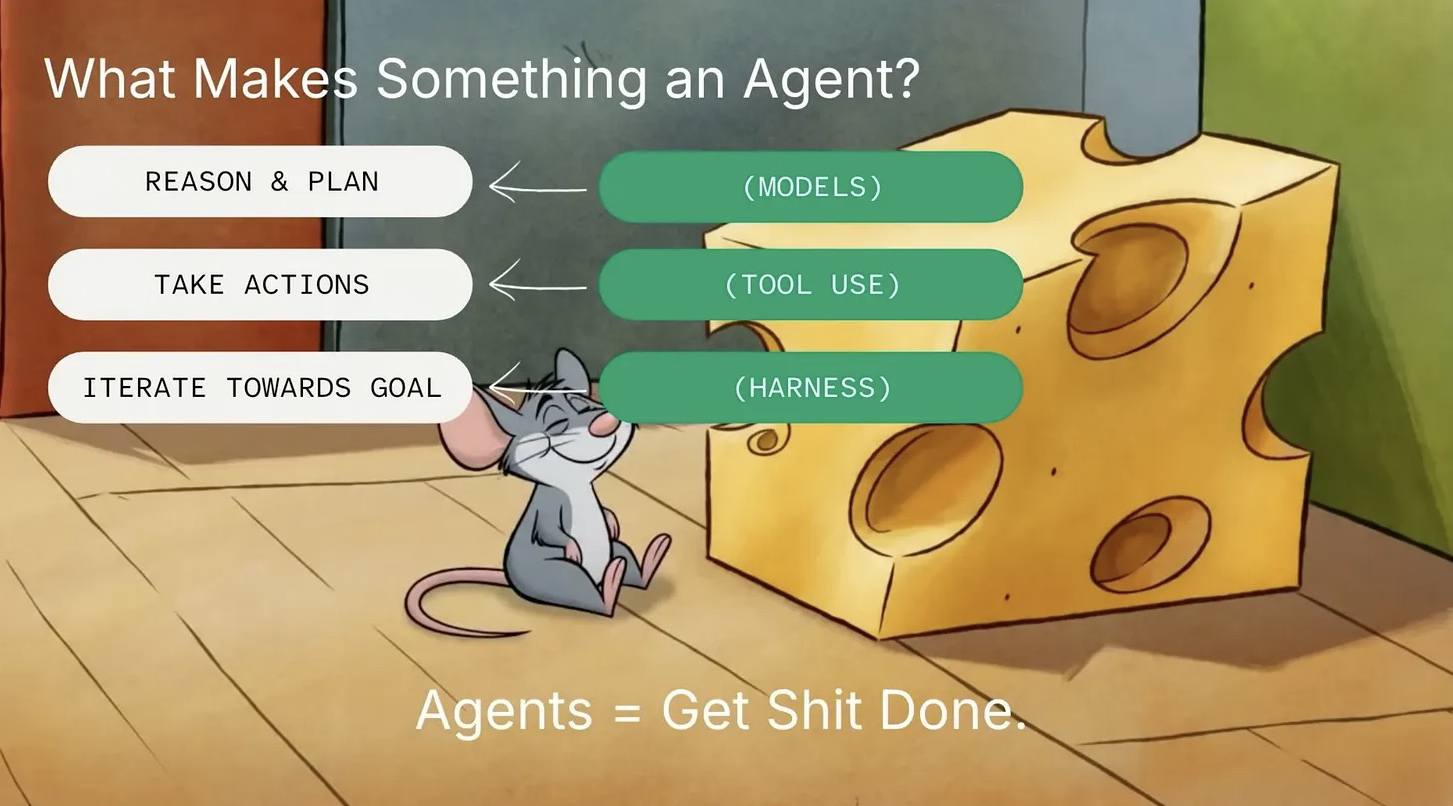
What's the best way to help agents get shit done?
They need to see exactly what tasks you can't stand doing. You need to show them that workflow, and provide context. This is the tricky part.
It takes a lot of time (meetings with management, and the actual people performing the tasks), you need a human in the loop (forward deployed engineer, or someone who understands AI implementation deeply), and then...
You can start to build the actual agent.
Tasks are step number 1. Task data is the new OIIL:
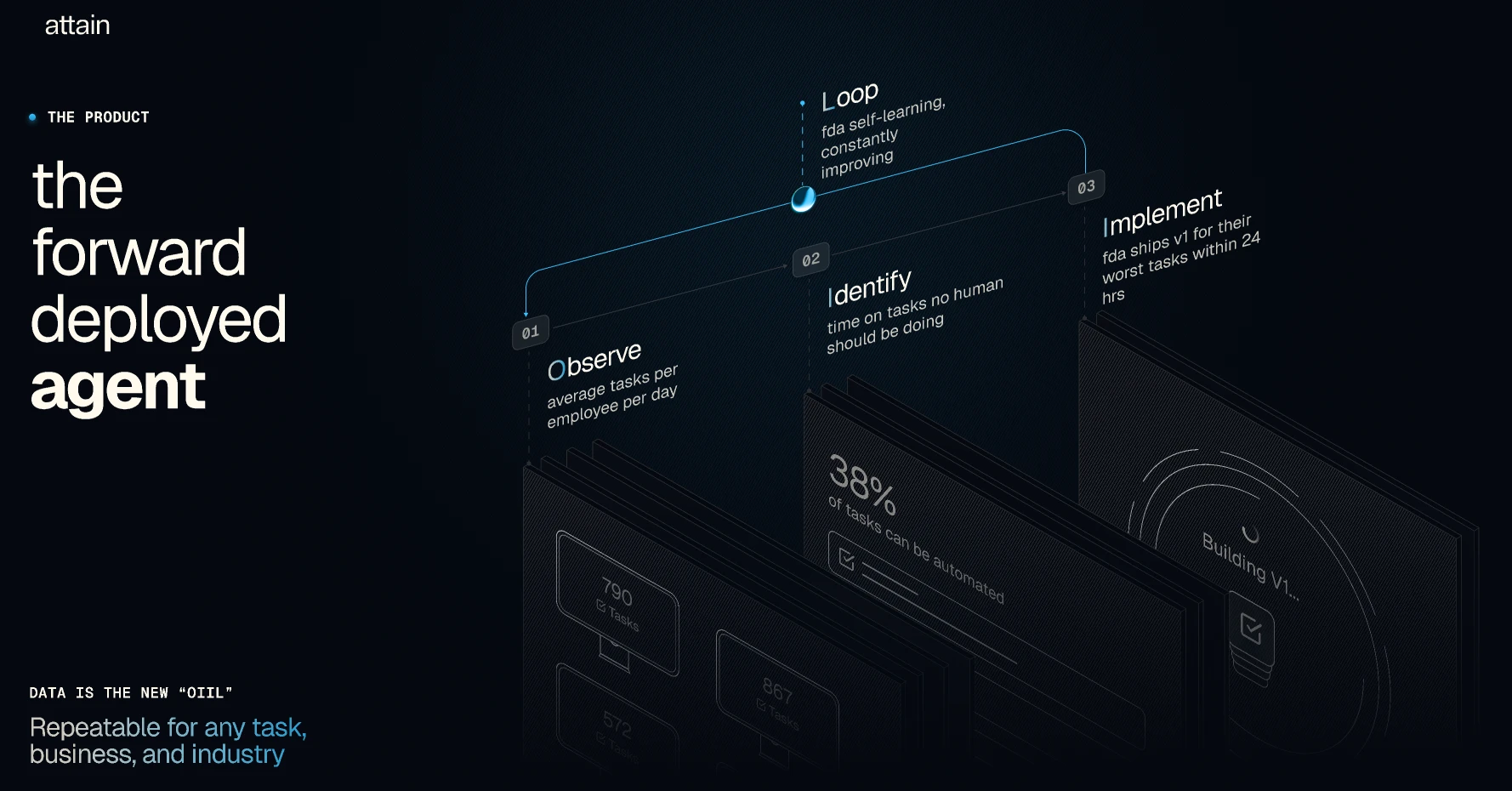
But the agent is still going to need training afterward. You have to onboard the agent.
Make sure you're monitoring and managing them actively. The loop phase is vital here. v1 of your agent is going to be buggy and clunky.
You have to crawl -> walk -> run -> fly. You have to iterate.
Here is a real-life example (and visual).
Take the SDR (sales development rep) who books meetings.
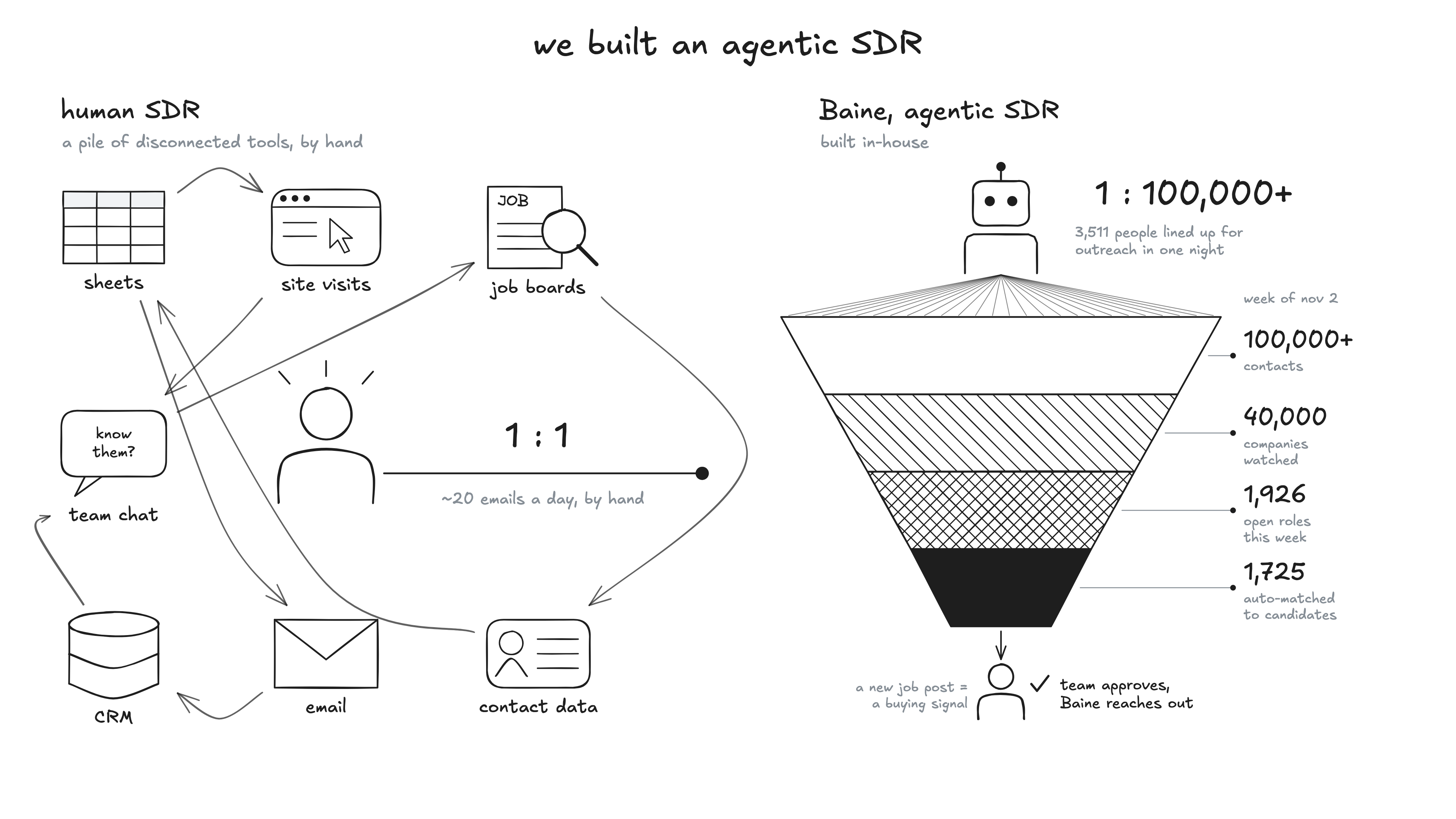
In 2021, the last time I built a go-to-market team (the old way), an SDR's day went like this:
Booking the meeting was the part SDRs loved (and what they were paid to do) and it came last.
In the first week of November, Baine, our agentic SDR, monitored 40,000 companies (all in our ICP) and spotted 1,926 open roles, each one a buying signal. One night, it lined up 3,511 people for outreach.
And booked 4 meetings.
Agentically. (automatically) What Baine (our agentic SDR) does by itself would have taken a team of 15 back then.
That leaves 1 SDR free to book meetings all day.

This is the beauty of agents, they scale infinitely, and are excellent at executing tasks that humans don't want to be doing in the first place...
Yes - it's a PITA to train them....
Just like a new employee, you have to architect their task execution perfectly and onboard them iteratively (it takes time).
But once you do - they get shit done.
Both Anthropic and OpenAI are in the staffing business. A forward deployed agent shows a business where AI fits, in two weeks.
Both Anthropic and OpenAI are in the staffing business.
Back in May, within a week of each other, the most advanced AI labs, with the best models available, each launched a company built to put engineers inside their customers.
The job they're staffing is the forward deployed engineer: an engineer embedded inside a customer until AI works.
Job postings for FDEs have grown by 3,500% since 2024; it's the fastest-growing role in tech.

Unsurprisingly, the pool of qualified candidates hasn't kept pace, and it's only just begun…
Tech giants have committed billions to putting more of them inside customers… and the Fortune 500 is paying dearly in implementation fees:
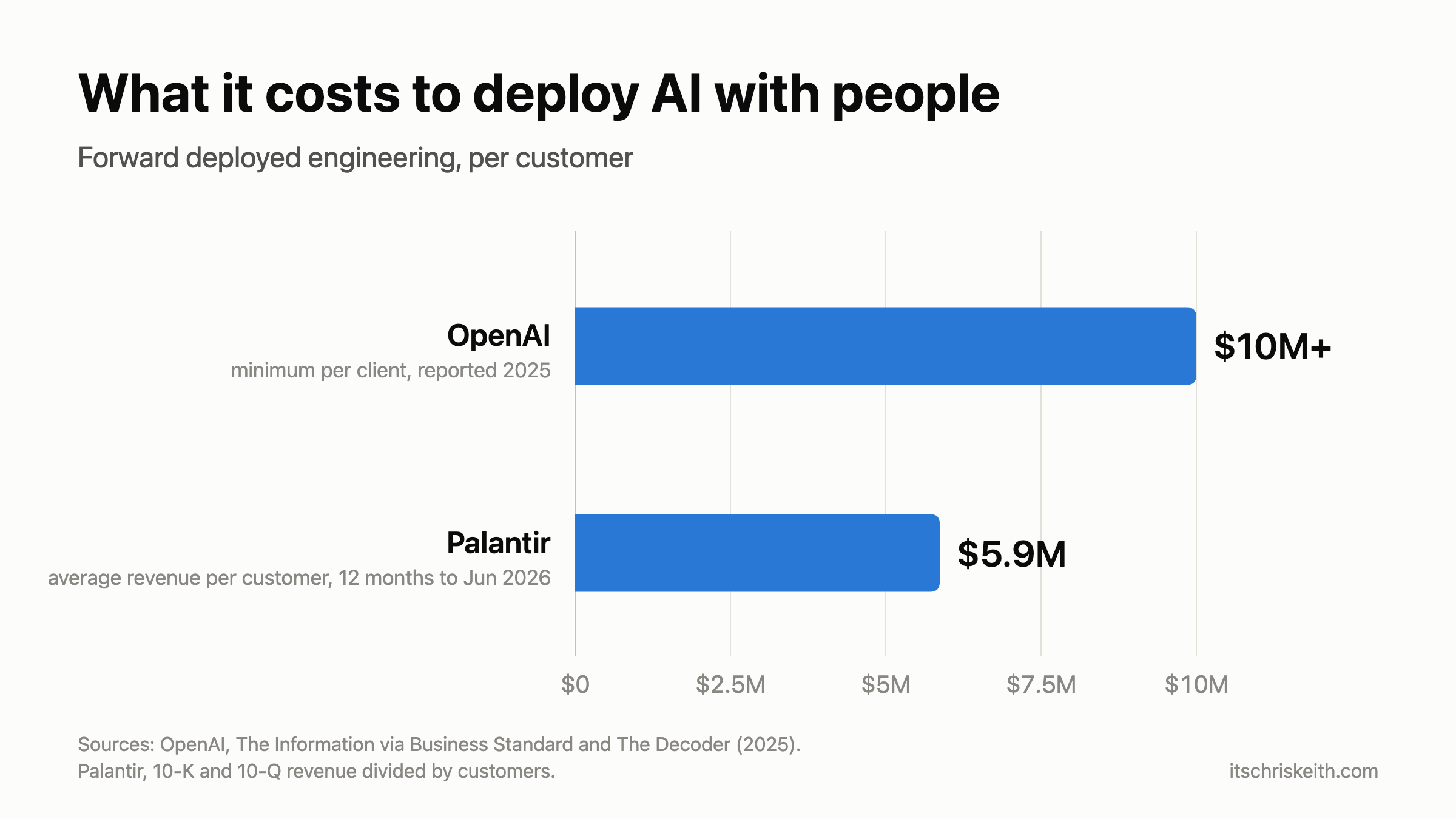
Why are FDEs necessary for AI implementation? And why are they so expensive?
So Main Street businesses find themselves in a conundrum.
SMBs want to implement AI, but they don't have the expertise or bandwidth to figure it out themselves.
Fortune 500 companies can afford to pay a $10M contract; 36 million SMBs can't, and it's shown in recent AI metrics:
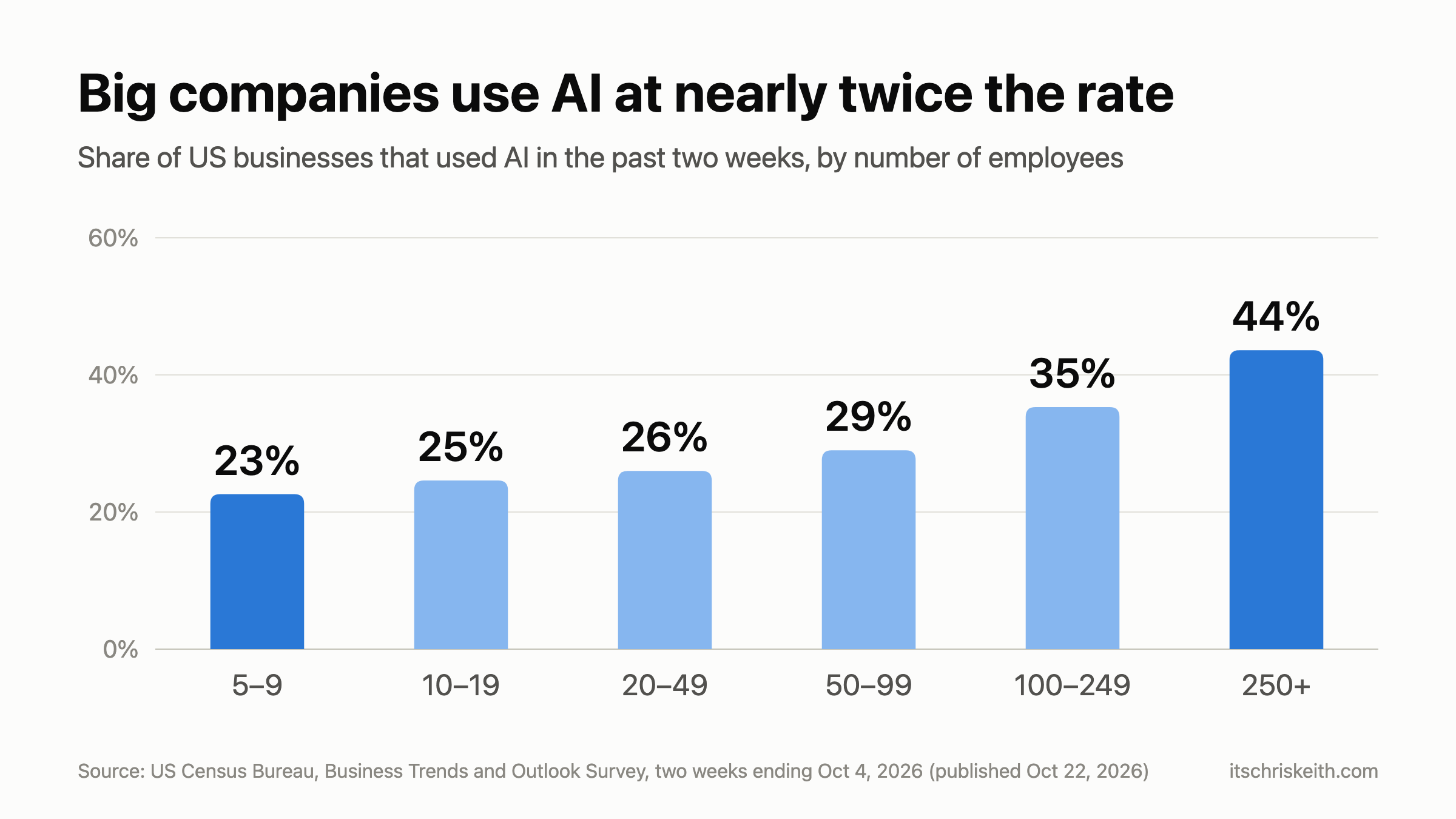
There hasn't been any sort of solution…
Until now:
At Attain, we built the Forward Deployed Agent.
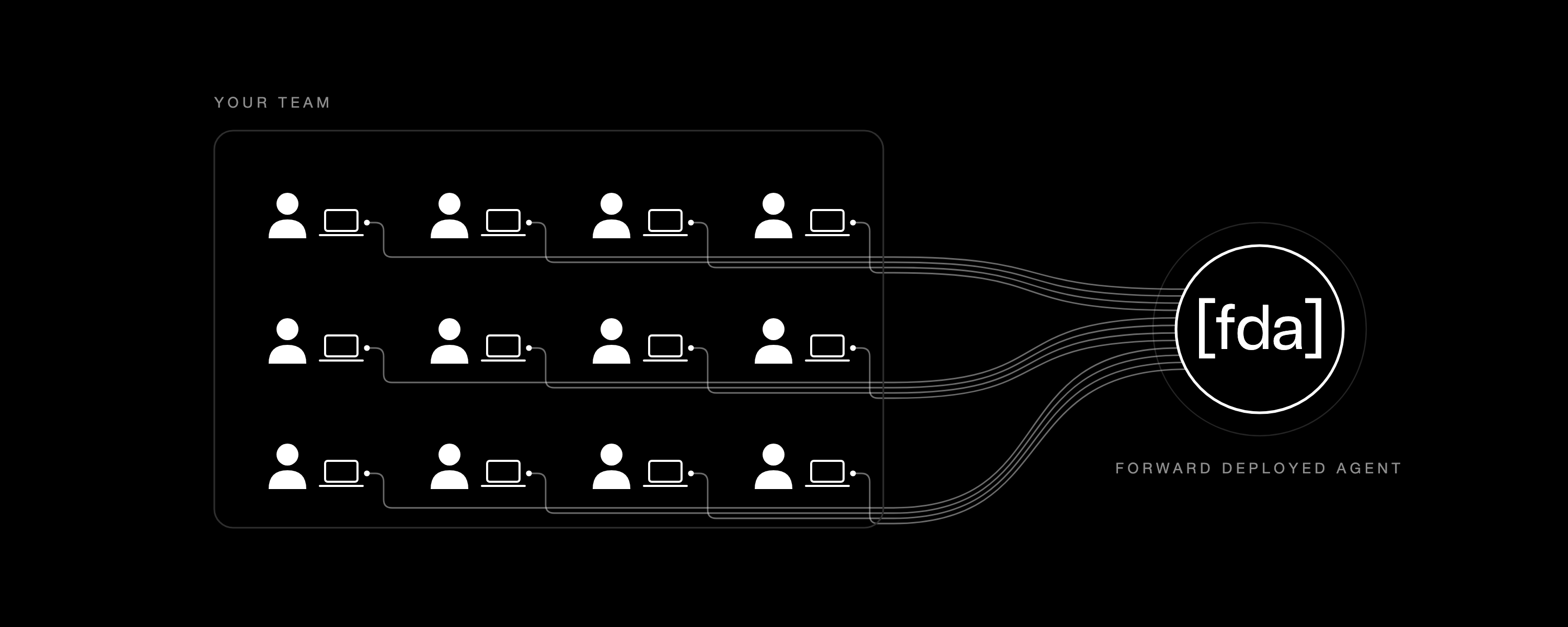
Our forward deployed agent [fda] installs on a team's computers in an instant. Over two weeks, it breaks down work into tasks: which apps, which steps repeat, where people carry information from one tool to the next by hand.
Then it hands back a map of where AI fits, which tasks are redundant and should never be performed by a human, which builds will have the biggest impact, and recommends which tasks to build first.
The first one ships within 24 hours.
We ran it on ourselves first. With its map, the same engineers who spent 78 weeks building Raine (our recruiting AI network engine) built Baine (our AI SDR) in 4.
20x faster to deploy and implement at 1% of the cost.
Jobs are breaking down into tasks, and each task is going to whoever does it best, a person or a model.
Our forward deployed agent [fda] shows a business which is which, across every computer, in two weeks. It's the fastest way in the world to deploy AI for Main Street businesses.
Looking to implement AI into your company, but don't know where to start?
In 1990, Michael Hammer wrote the playbook for building work around outcomes. Thirty-six years later, AI makes it the operating model.
July 1990. Michael Hammer tells Harvard Business Review readers to stop using computers to speed up procedures built before computers existed.
October 2026. I'm in my West Village breakfast nook with a coffee, reading Michael Mignano's rewrite of Hammer's article for the AI era.
Every line still applies.
It reads like a memo about this year's AI rollouts… Only it was written 36 years ago!
We have been trying to solve this problem for my entire life.
John Gall wrote The Systems Bible; it's one of the best business books of all time. Please read it if you haven't!
A few of his rules:
Fast forward to obliteration in 2026.
Fred Wilson (legendary NYC VC) made Hammer's argument a Union Square Ventures thesis in 2015. Mignano brought it back this summer for AI.
Hammer wrote the same discipline down in 1990 as seven principles, each set in italics. They are the principles we have been trying to implement for 36 years:
Every business wants to use AI right now, but they don't know where to start.
Start with one outcome.
Apply one of Hammer's principles to it, check the results and expand from there. It'll be messy and broken day one, but after 30 days, it'll be a lot cleaner, and you'll have built a new habit! (Internally, we call this process crawl, walk, run, fly.)
That's how software gets built; it's an iterative process, and it's how a company rebuilds itself around outcomes.
Work is changing. Jobs are breaking down into tasks, and each task is going to whoever does it best, a person or a model.
This transition will usher in the outcome-based economy.
Hammer's first principle was to build each job around an outcome. AI (finally!) turns that principle into the operating model. Every company now has to redesign its work, its jobs, and its structure around outcomes. You have to adjust how you think about 'work' from first principles, starting with outcomes.
As history shows, it's going to take more time than you think.
Work moved from the field to the factory to the screen. The third move is to outcomes. Here's how Attain gets us there.
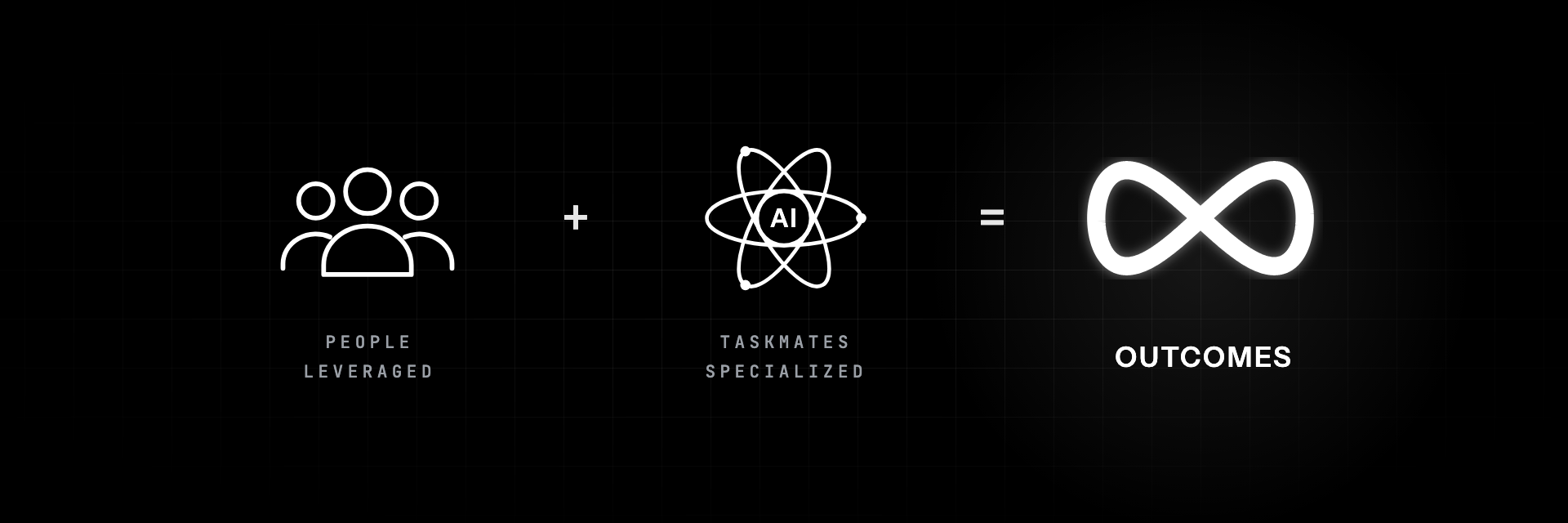
Work has moved twice: from the field to the factory in the Industrial Revolution, then from the factory to the screen in the Digital Revolution.
The third move, the Outcome Revolution, has started.
For the past sixty years, work has meant sitting hunched at a screen, clicking a mouse and copying and pasting. People work until 3am adjusting PowerPoint slides and tweaking made-up numbers in a financial model. We look back at the people who built the pyramids and can’t believe how they worked; one day soon, people will look back at us the same way.
Attain exists to speed the move from the copy-and-paste economy to the outcome-based economy. Jobs are breaking down into tasks, and each task is going to whoever does it best, a human or a taskmate, our word for an agent built for one role.
The biggest lever we have is learning how every role’s work gets done, and the Forward Deployed Agent, or [fda], is the first step.
The Forward Deployed Agent [fda] installs on a team’s computers and learns the work in two weeks. It breaks each role into tasks and hands back a map of what to build first. We then build taskmates for the repeat tasks and teach the team to orchestrate them.
We’re early, and to some, this feels intrusive.
That’s ok, it’s supposed to.
In 2013 Elon said Teslas would drive themselves for 90% of miles within three years. It took thirteen years, and Tesla’s cars have now driven themselves 17 billion miles. Granola launched in May 2024. Recording every meeting felt invasive, and now it’s standard practice.
Tasks are next.
Models keep getting smarter and still fall short on the last mile. Andrej Karpathy calls it the march of nines: a demo that works 90% of the time is only the first nine, and getting to 99%, then to 99.9%, takes the same amount of work each time.
The last mile is where Attain works. Every taskmate we place makes every other taskmate in that role better, so the SDR taskmate at company fifty starts with everything we learned at the first forty-nine. A role we learn once carries to the same role in every industry.
Three problems hold work at the screen.
The [fda] works in the background, so it addresses all three. Its map is the written record of how the work gets done, so a taskmate arrives knowing the role and comes to you with the tasks it can take this week. Then the [fda] teaches the team the new habit of orchestrating taskmates.
That makes Attain a digital labor company. Our taskmates deliver outcomes, role by role.
Every kind of work so far has kept people at the task: in the field, on the factory floor, at the screen. In the outcome-based economy, people own outcomes, and taskmates handle the tasks.
Computers have had three interfaces in about eighty years. First you handed over the whole program, then you gave every step, and now you type what you want each time you want it. The fourth works like a great hire: you name the outcome once, and the tasks are handled, because the taskmate already knows the role.
A business owner will say “I want ten meetings this week,” and the SDR taskmate will handle the lists, the emails and the follow-ups. Then everyone orchestrates a team of taskmates, and a twelve-person business runs with the output of twelve hundred.
Martin Casado said on Invest Like the Best that “the biggest constraint is no longer the tech.” The constraint is our creativity, worn down by thirty years of software that was hard to use.
The future of work is human orchestration.
Come build it with us.
How we evolved ReelCV into PeopleGPT with natural-language search, contextual matching, profile scoring, and recruiter-first workflows.
By the end of August, ReelCV was live. It gave candidates a richer way to show who they were, but it also created a new problem: we had better profiles and no fast way to find the right one.
That is where this story begins.
If you want the first chapter, start with How We Built ReelCV. I am leaving that story exactly where it ends, with the August launch. This is what happened next.
August was the handoff from ReelCV to what we started calling PeopleGPT internally.
ReelCV had already done the hard work of turning a flat CV into a structured, much more human candidate profile. Now we had to make thousands of those profiles useful to a recruiter in the middle of a real search.
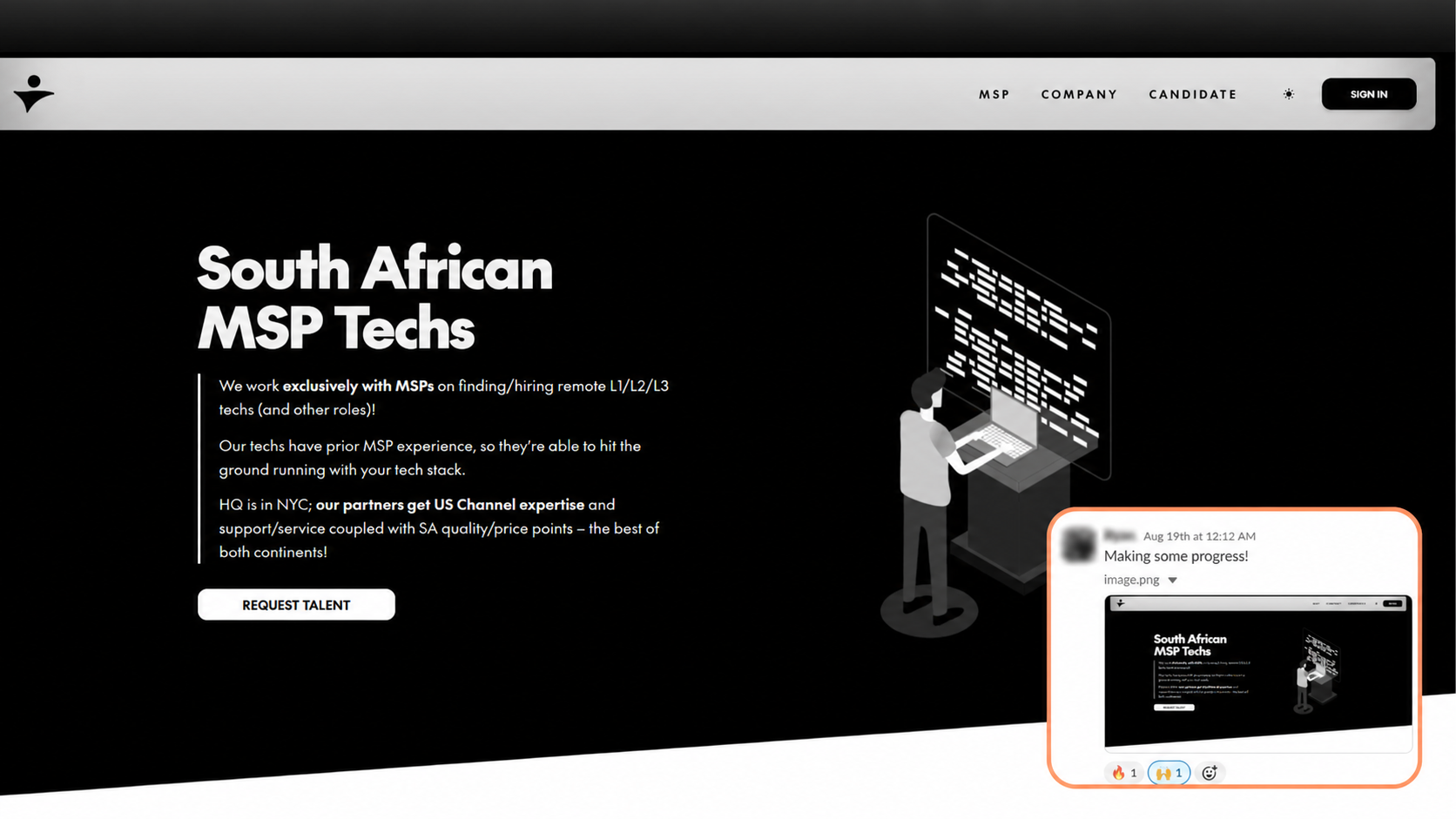
The first step was making the company side of the product feel like one connected experience. Search, job listings, company profiles, recruiter ratings, and hand-picked deliverables all needed to work together.
The bigger idea was simple: recruiters should not have to think like a database. They should be able to describe the person they need in normal language and get back a small number of genuinely useful matches.
On September 11, we walked through the company search experience in a working product.
Instead of stacking rigid filters, a recruiter could type something like, “I am looking for an L1 tech with two years of MSP experience, ideally at a US company,” and let the system interpret the context.
That changed the job of search. It was no longer about returning every profile that matched a keyword. It was about understanding the request, weighing different signals, and surfacing the handful of people a recruiter should actually review.
That was the moment the evolution from ReelCV to AI-powered search became obvious.
A clean demo is easy. Real recruiting work is messy.
Job descriptions are inconsistent. Clients care about things they forget to write down. Two candidates can have the same title and completely different experience. We needed to know whether the search could handle all of that.
So we started testing it against actual job listings and the kinds of requests our recruiters received every day.
Every test forced us to make the product more practical. The system needed to:
This is where the product started learning the difference between a technically correct result and a useful one.
A search box by itself is not a product.
Companies still needed a clear place to manage job listings, see the candidates we recommended, and understand what was happening around each search. Our recruiters needed the same information without creating another disconnected workflow.
Over the following weeks, we connected search to company profiles, active roles, recruiter workflows, and hand-picked deliverables. Candidate results became easier to scan, the company side became easier to navigate, and the whole experience started to feel like one system.
That mattered because the value was never the search box. The value was helping a company move from “who are we looking for?” to a credible shortlist without wasting days digging through profiles.
We kept putting the product in front of the people who would actually use it.
Recruiters tested searches, reviewed the candidates PeopleGPT returned, and showed us where the rankings made sense and where they did not. We also looked at how the company experience and our internal admin tools worked together.
The feedback was the product work. Every weak result exposed a missing signal. Every confusing screen showed us where the workflow needed to be simpler. Every useful shortlist gave us more confidence that the idea could work at scale.
Over those next several weeks, PeopleGPT stopped feeling like a feature attached to ReelCV. It became the search and matching layer built on top of everything ReelCV had made possible.
ReelCV made candidate profiles richer and more human. PeopleGPT made thousands of those profiles searchable and actionable.
That was the real evolution. We did not throw ReelCV away and start over. We used the structure, skills, context, and candidate data we had already built, then gave recruiters a faster way to find the right person inside it.
What happened next became Raine. That is a separate story, and I will tell it in its own post.
For now, you can see what we are building at Hirexe.

TL;DR: Despite all the talk about "artificial" intelligence, the biggest names in AI are spending billions of dollars on human labor.
From the $500M+ that Mercor is making connecting PhDs to AI labs, to Scale AI's $2B+ in revenue from human data workers, to Surge AI crossing $1.4B with just 121 employees managing human annotators—the AI revolution is actually powered by an invisible army of human experts doing the grunt work that makes these "intelligent" systems possible.
About 80% of the explosive revenue growth we’ve seen between the above companies is coming from STAFFING revenue. The AI industry has a dirty little secret, and it's hiding in plain sight.
While Silicon Valley VCs throw around terms like "artificial general intelligence" and "autonomous systems," the reality is far more human than anyone wants to admit. Behind every breakthrough language model, every impressive AI assistant, and every mind-blowing demonstration lies an army of human workers—annotating data, providing feedback, and essentially teaching machines how to think.
The numbers tell a story that the AI hype machine doesn't want you to hear: the companies making the most money in AI aren't the ones building the flashy chatbots—they're the ones managing the human workforce that makes those chatbots possible.
Mercor's story reads like a Silicon Valley fever dream. Founded by three 21-year-old college dropouts in 2023, the company started as a recruiting platform for college students. Fast forward to September 2025, and Mercor is reportedly approaching a $450 million annual run rate with investors eyeing a $10+ billion valuation.
What changed? AI labs discovered that Mercor was sitting on exactly what they desperately needed: access to thousands of domain experts with advanced degrees.
The Numbers Behind Mercor's Explosion:
Here's what Mercor actually does for AI companies: they connect graduate-level experts—physics PhDs, biology researchers, legal experts, medical doctors—with AI companies that need specialized knowledge to train their models. When OpenAI needs someone who understands quantum mechanics to help improve GPT's physics reasoning, or when Anthropic needs constitutional law experts to help Claude understand legal nuances, they turn to Mercor.
Mercor's business model is brutally simple: charge a 30% fee on every expert they place. With AI companies paying premium rates for specialized talent (often $50-200+ per hour), Mercor's take per placement is substantial. The company has been profitable since early 2025, generating $1M+ in profit just in February alone.
The kicker? CEO Brendan Foody recently posted that their ARR is actually higher than $450 million—suggesting they're on track to hit the $500 million milestone faster than almost any enterprise software company in history.
Scale AI tells perhaps the most revealing story about AI's human dependency. Founded in 2016, Scale positioned itself as the infrastructure layer for AI training data—but what they really built was the world's most sophisticated human workforce management system.
Scale AI's Staggering Numbers:
Here's what's wild about Scale: Meta just paid $14.3 billion for a 49% stake in what is essentially a human resources company. Think about that for a moment. The company that owns Facebook, Instagram, and WhatsApp—with all their technical expertise—decided they needed to pay nearly $15 billion to access Scale's network of human data workers.
What Scale's Army Actually Does:
Scale operates massive facilities in Southeast Asia and Africa through their Remotasks subsidiary, employing tens of thousands of workers who spend their days training tomorrow's AI systems. They've built the McDonald's of AI training—standardized, scalable human intelligence that AI companies can't replicate internally.
The Meta acquisition reveals the secret: Scale's real value isn't their technology—it's their ability to coordinate hundreds of thousands of humans to improve AI systems at massive scale.
While everyone was watching OpenAI and Anthropic, Surge AI quietly built the most profitable human intelligence operation in AI history. Founded in 2020 by former Google and Meta engineer Edwin Chen, Surge took a different approach: bootstrap profitability from day one.
Surge AI's Incredible Economics:
This might be the most impressive business in all of AI. Surge generates over $11 million in revenue per employee—a number that makes even the most successful SaaS companies look inefficient. How? They've perfected the art of human intelligence arbitrage.
Surge's Secret Sauce:
Unlike Scale's volume approach, Surge focuses on premium, specialized data work that requires deep expertise. When AI labs need the absolute highest quality human feedback—the kind that can make or break a model's performance—they pay Surge's premium prices.
Chen's anti-VC approach has created something rare: a massively profitable company with complete control over its destiny. While other AI companies burn billions chasing growth, Surge prints money by connecting highly skilled humans with AI companies willing to pay top dollar for quality.
Handshake's transformation story might be the most surprising of all. Started in 2014 as a career network for college students, Handshake spent a decade building what they didn't realize was the perfect infrastructure for the AI boom.
Handshake's AI Pivot Numbers:
What makes Handshake unique: they already had the trust and relationships with universities and students that other companies would spend years building. When AI labs started desperately seeking PhD-level experts for training data, Handshake realized they were sitting on a goldmine.
Handshake AI's business model is straightforward: connect their verified network of graduate students and recent PhD recipients with AI companies that need domain expertise. Physics students help improve AI reasoning about quantum mechanics. Biology PhDs help models understand complex molecular interactions. Legal scholars help AI understand constitutional law.
The beauty of Handshake's position is trust and verification. While anyone can claim to be an expert online, Handshake's university partnerships mean they can verify credentials and academic standing. AI companies pay premium rates for this level of verification.
To understand why companies like Mercor, Scale, Surge, and Handshake are growing so fast, you need to look at where the big AI companies get their money—and how much they're willing to spend on human intelligence.
1. OpenAI
2. Anthropic
3. Google DeepMind
4. Meta AI
5. xAI (Elon Musk)
6. Microsoft (through OpenAI partnership)
7. Amazon (Bedrock + Anthropic)
Total Market Math: These seven companies have a combined market cap/valuation of over $7 trillion and are collectively spending an estimated $3+ billion annually on human data work. That's enough to support the massive growth we're seeing in companies like Mercor, Scale, Surge, and Handshake.
The secret to understanding AI's human dependency lies in a technical concept that sounds boring but is absolutely critical: Reinforcement Learning from Human Feedback (RLHF).
Here's the dirty secret about large language models: they don't actually understand anything. They're essentially extremely sophisticated autocomplete systems that predict what word should come next based on patterns they've seen in training data.
The problem? Raw prediction doesn't create useful AI assistants. A model trained only on internet text might complete "How do I cook chicken?" with accurate information—or with a conspiracy theory, a joke, or instructions for something dangerous. RLHF is how AI companies teach models to be helpful, harmless, and honest.
The RLHF Process:
This process is labor-intensive and requires skilled human judgment. You can't just hire anyone—you need people who understand the domain, can spot subtle errors, and can make consistent quality judgments.
The numbers around RLHF are staggering:
Training GPT-4 Level Models Requires:
Types of Human Experts Needed:
This is why companies like Mercor (PhD experts), Scale (massive workforce), Surge (premium specialists), and Handshake (verified academics) are growing so fast—they've built the infrastructure to deliver human expertise at the scale AI companies need.
Here's what most people don't realize: RLHF isn't a one-time process. As AI models get more sophisticated, they need more sophisticated human feedback. Consider what's coming:
Next-Generation Feedback Needs:
Each of these advances requires new types of human expertise and even more human feedback. The companies that can deliver this feedback will only become more valuable.
Beyond training AI models, there's another massive human-powered industry growing: AI evaluation and testing.
Every AI company needs to answer the same questions:
The answer requires human evaluation at massive scale.
Current AI Benchmarks and What They Test:
The Human Element: Every one of these benchmarks required hundreds or thousands of hours of human expert time to create, validate, and score. And they need to be constantly updated as AI models improve.
As AI models get better, evaluation becomes more challenging and expensive:
Evolution of AI Benchmarks:
Cost Escalation: Evaluating a single AI model on comprehensive benchmarks now costs $1,000-10,000 per model. With dozens of major models and constant updates, the evaluation market is easily worth hundreds of millions annually and growing.
Key Players in AI Evaluation:
Why evaluations will keep growing:
Conservative estimates suggest the AI evaluation market will reach $10+ billion annually by 2030, with the majority of that spending going to human experts who design, run, and interpret these evaluations.
The AI industry's dirty secret isn't just that humans are powering current AI—it's that humans will likely be essential to AI development for the next decade or more.
As AI systems become more capable, they actually require more sophisticated human feedback, not less:
The Scaling Challenge:
Each advance multiplies the need for human expertise.
The companies we've examined aren't temporary solutions—they're building sustainable economic moats:
Mercor's Moat: Exclusive relationships with 1,500+ universities and 18M+ students. New competitors would need years to build similar trust and scale.
Scale's Moat: 300,000+ trained workers, operational infrastructure across multiple countries, and enterprise relationships with every major AI company.
Surge's Moat: Premium positioning with top AI labs and a proven ability to deliver quality at massive scale with minimal overhead.
Handshake's Moat: University partnerships and verified credential systems that competitors can't easily replicate.
The numbers don't lie. AI companies are doubling down on human infrastructure:
These aren't temporary investments—they're strategic bets that human intelligence will remain essential to AI development.
Strip away the hype, and the AI industry looks like this:
Layer 1: Foundation Models (OpenAI, Anthropic, Google)
Layer 2: Human Intelligence Platforms (Mercor, Scale, Surge, Handshake)
Layer 3: AI Applications (Everything else)
The money flows up: Application companies pay foundation model companies, who pay human intelligence platforms. The most profitable layer isn't the one with the most hype.
For Workers: The AI revolution isn't destroying knowledge work—it's creating massive demand for human expertise. PhD graduates, domain experts, and skilled evaluators are in higher demand than ever.
For Companies: Success in AI increasingly depends on access to human intelligence at scale. Companies that can coordinate human expertise will have sustainable advantages over those that can't.
For Investors: The "picks and shovels" play in AI isn't semiconductors or cloud computing—it's human intelligence platforms.
Three scenarios for human involvement in AI:
Scenario 1: Continued Growth (Most Likely)
Scenario 2: Gradual Automation (Possible)
Scenario 3: AI Self-Sufficiency (Unlikely in 10 years)
Most experts believe Scenario 1 is most likely because the complexity of human values and the pace of AI advancement suggest that sophisticated human feedback will remain essential for much longer than most people realize.
The real AI revolution isn't happening in the sleek labs of OpenAI or the data centers of Google. It's happening in the distributed network of human experts who are teaching machines how to think.
Behind every impressive AI demo, every breakthrough capability, and every billion-dollar valuation lies an invisible army of humans:
The companies that have figured out how to coordinate this human intelligence at scale—Mercor, Scale, Surge, Handshake—aren't just service providers. They're building the nervous system of the AI economy.
The dirty little secret is out: AI isn't replacing humans—it's creating unprecedented demand for human expertise. The companies that embrace this reality, rather than fighting it, will be the ones that capture the real value in the AI revolution.
The future of AI isn't artificial intelligence replacing human intelligence. It's human intelligence and artificial intelligence working together at previously unimaginable scale. The companies that master this combination won't just participate in the AI revolution—they'll control it.
And that might be the most human outcome of all.
Hiring hasn’t changed much in decades. Recruiters wade through endless resumes, candidates struggle to showcase who they truly are, and companies rely on paid demos and clunky trial processes. We wanted to flip the script: create a platform that surfaces exclusive, vetted talent, highlights personality and skills, and streamlines the recruiting process. That vision became ReelCV.
Here’s how we built it, month by month, behind the scenes.
ReelCV started with a rough concept I shared on LinkedIn. I used AI to turn the idea into a first mockup, and it looks almost nothing like what we eventually shipped. That was the point: it gave us something concrete to react to, test, and improve.
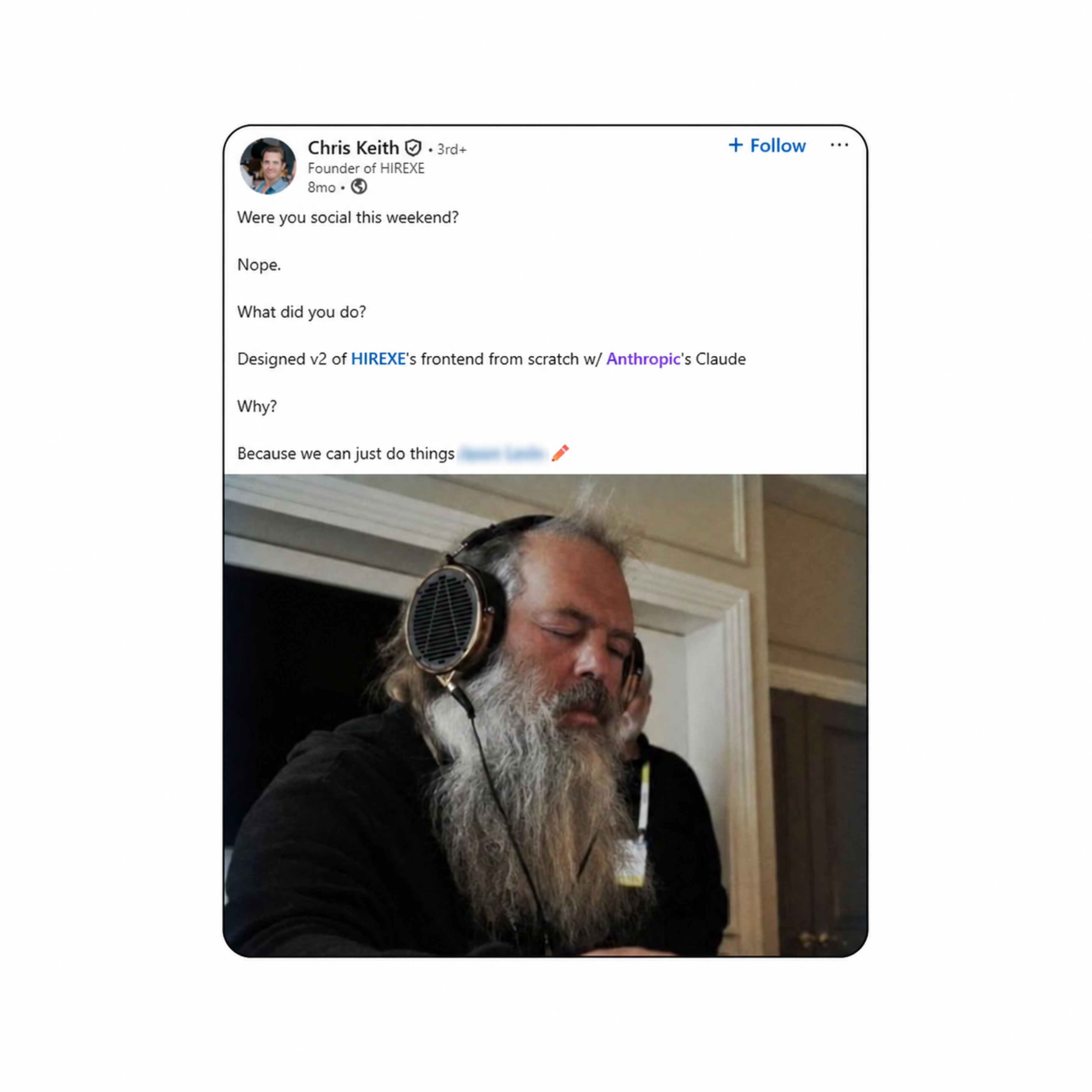
That first design was not meant to be polished. It was a starting point that helped us move from an idea in my head to something we could build.
What came next was six months of iteration. We kept the parts that worked, discarded the parts that did not, and let real feedback shape the product.
March was when we started turning the concept into a real product. We focused on the foundations: profile scoring, recruiter workflows, and the first working version of the platform.
Early in the month, Ryan and I explored how recruiters actually evaluate candidates. We discussed profile scoring as a way to quantify both “red flags” and positive signals across a candidate’s career.
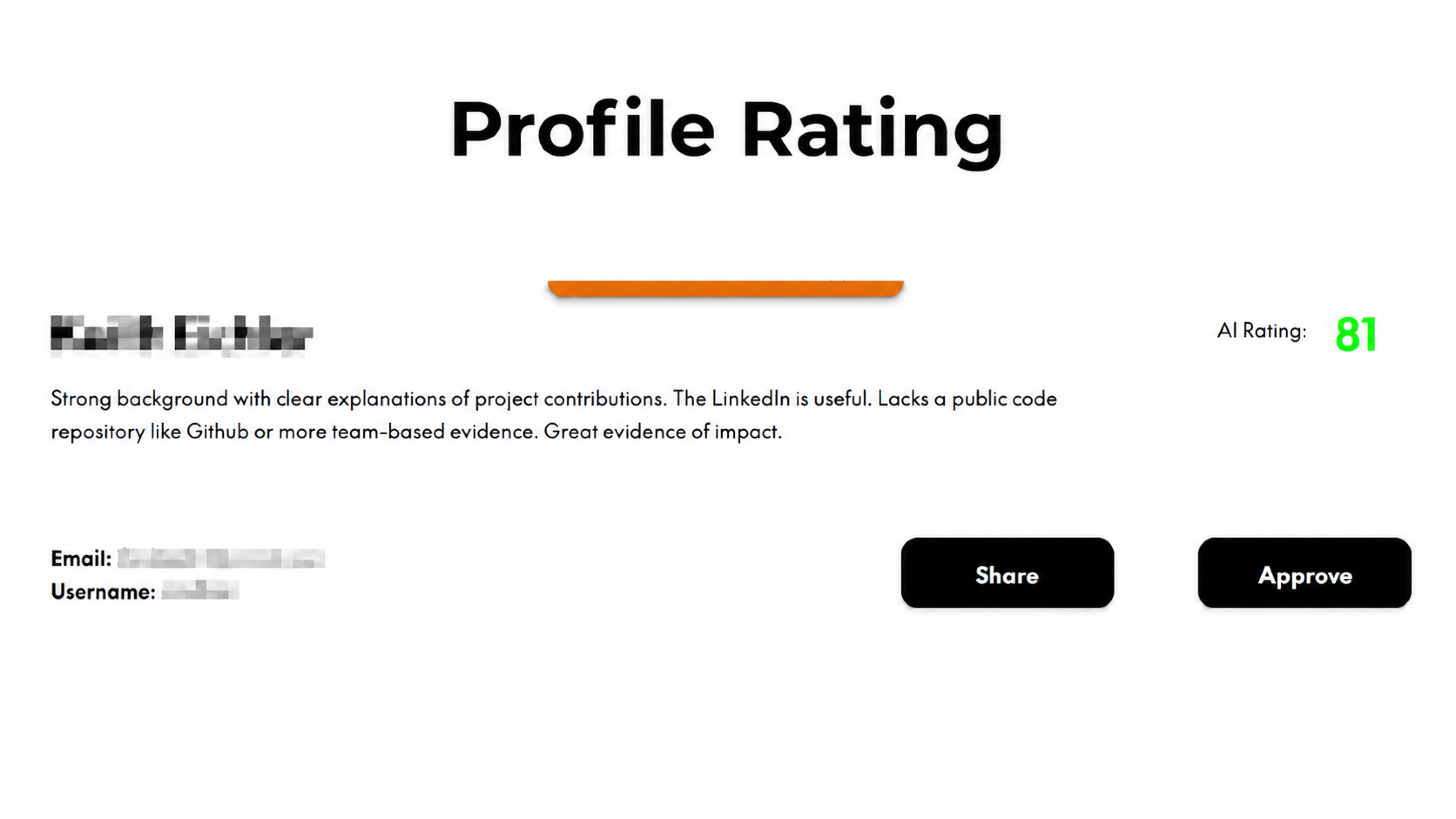
The goal was simple: instead of asking recruiters to scan manually for these patterns, ReelCV would apply weighted scoring automatically. It would surface the candidates most likely to succeed and flag potential concerns. That became one of the product’s most important differentiators: a data-driven way to evaluate people, not just paper resumes.
Ryan had begun improving the user and admin experience inside the Hirexe platform. The focus was on precision over volume: rather than overwhelming recruiters with dozens of irrelevant candidates, the system would present a handful of highly relevant profiles.
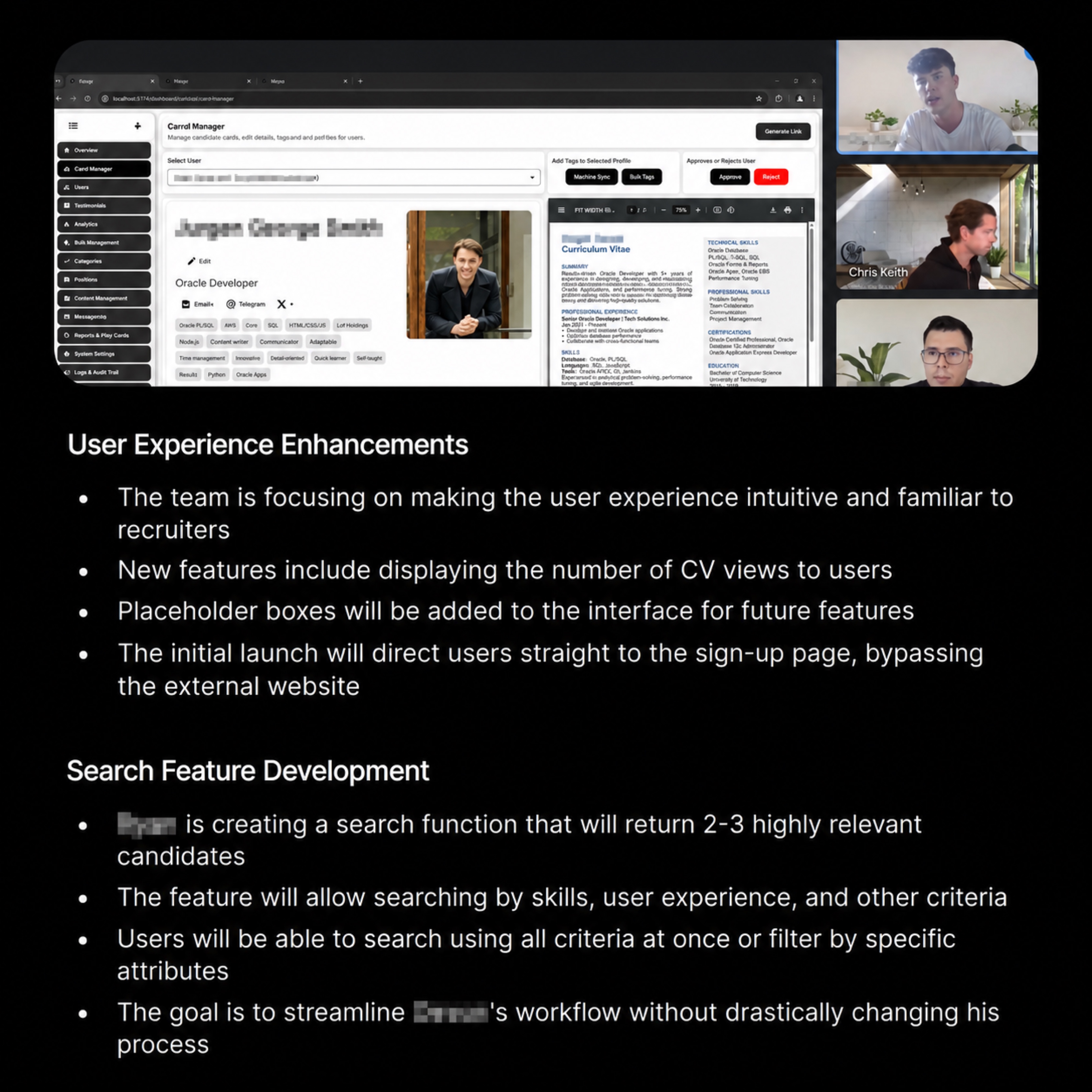
The work included:
This was the first step toward shaping ReelCV as a practical tool recruiters could adopt quickly, rather than a flashy product that disrupted workflows.
I pushed for a clearer, more structured experience, including small usability details like CV view tracking. That feedback helped keep the product grounded in what recruiters actually needed, not just what looked good on paper.
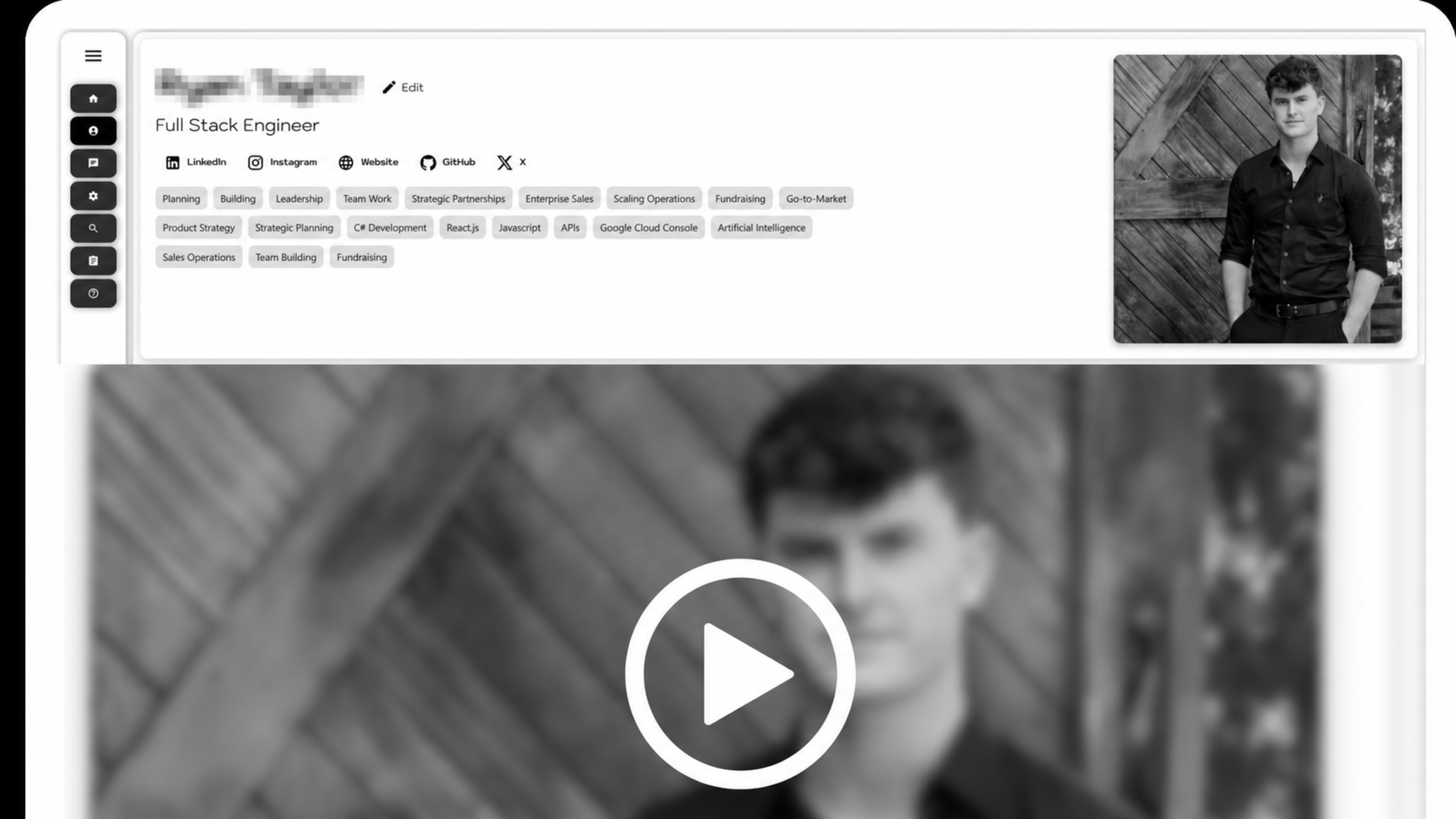
By March 15, ReelCV hit its first major milestone: V1 was ready. It was more than a prototype. It was the foundation for every iteration that followed. Recruiters could log in, create candidate profiles, and begin to see how ReelCV might reshape the hiring process.
A week later, however, a problem surfaced. Despite video being central to the ReelCV vision, candidates weren’t uploading their videos. Technical friction, strict validation, and unclear guidance caused drop-offs. Without videos, the “Careel” (career reel) concept couldn’t deliver on its promise of dynamic storytelling.
I flagged video uploads as a bottleneck. On March 20, Ryan made video a required step in profile creation.
That change increased adoption and ensured every profile included the feature that made ReelCV different.
Toward the end of March, we started planning V2 improvements to how candidate skills were extracted, tagged, and presented. Those conversations set up the refinements we would make in April and May.

March was about building ReelCV’s foundation. We moved from scoring models and recruiter workflows to layout improvements and a working V1. Video uploads exposed gaps, but those gaps forced us to build a stronger product.
ReelCV had officially moved from idea to implementation.
If March was about laying the foundation, April was about giving ReelCV a personality. We shifted from raw functionality to human-centered design, looking for ways to show candidates as more than static resumes and make the recruiter experience feel smooth, modern, and intuitive.
At the start of April, we reviewed the original homepage. It worked, but it felt more like a traditional database than a modern hiring platform. Ryan and I began redesigning the flow around search as the entry point. Recruiters would land on a search-driven homepage and start finding candidates immediately.
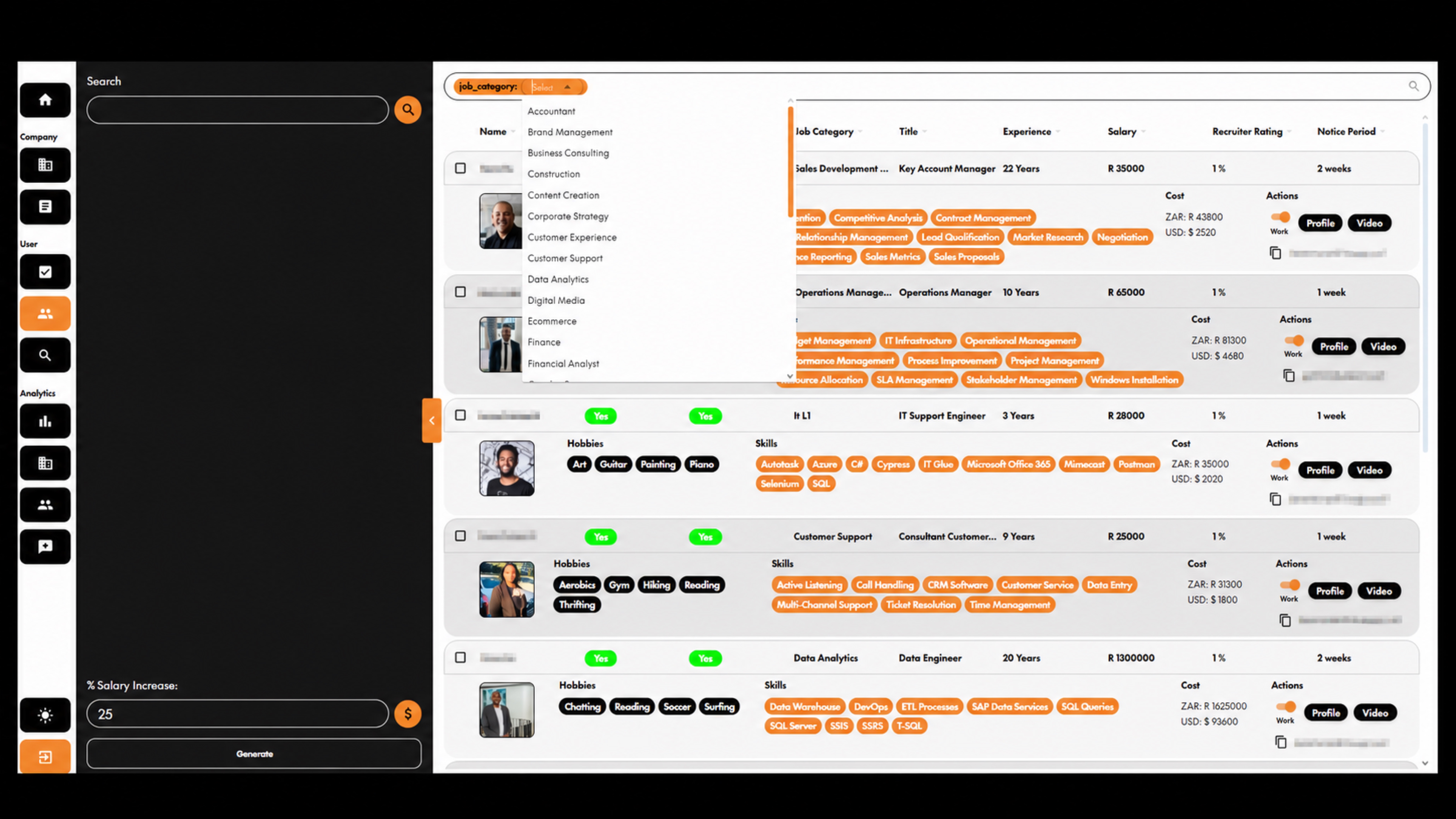
Ryan demonstrated updates that made the experience more engaging:
The shift was subtle but significant: ReelCV started to feel less like a form-filling system and more like a dynamic tool that guided recruiters and candidates forward.
By April 8, the conversation turned to one of the most defining elements of ReelCV: capturing personality.
We debated how to move beyond credentials and show people as individuals. We landed on a new profile structure that highlighted hobbies, passions, and personality traits alongside professional skills. It included:

This was a turning point. ReelCV was not just making recruiters more efficient. It was creating a more authentic, human-centered hiring experience.
By mid-April, we were refining the Career Profile, which became the centerpiece of the candidate experience.
Key updates included:
We also debated the value of fields like “About Me” and “My Future,” weighing authenticity against clutter. It was the same balancing act we faced throughout the build: depth versus clarity, personality versus professionalism.
As April progressed, Ryan rolled out design refinements that gave the product a more modern polish:
Even small choices, like limiting orange so it retained its impact, showed how deliberately we were shaping ReelCV’s identity.
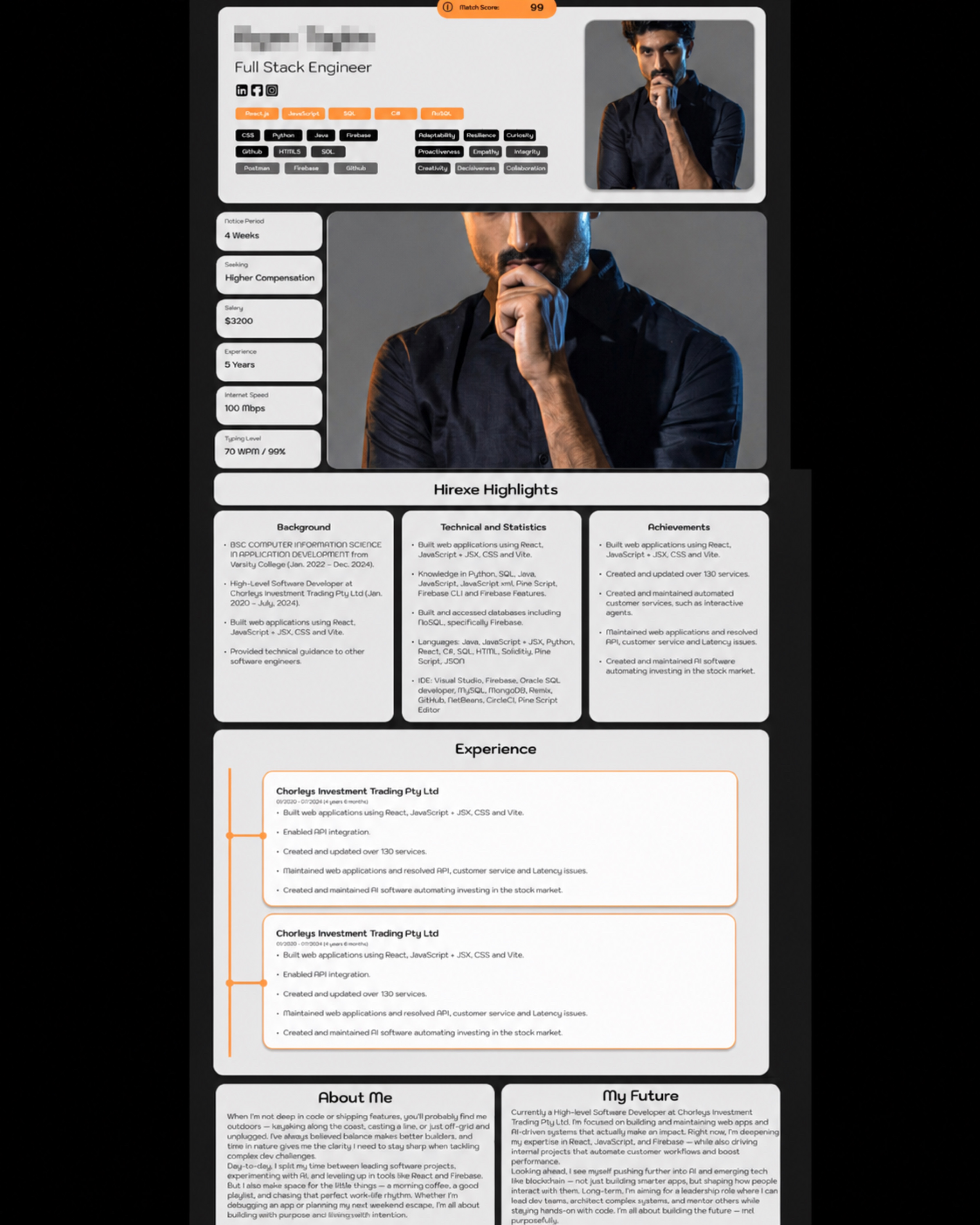
April was when ReelCV started to feel alive. We moved from a functional V1 to something with warmth, personality, and a clearer voice. Profiles were no longer just digital CVs. They became windows into a candidate’s story. Recruiters were not just searching. They were moving through a more intuitive, guided workflow.
With these changes, ReelCV moved closer to its core promise: making hiring both efficient and human.
By May, ReelCV was crossing the line from concept to working product. Long-discussed features became operational, and for the first time, we could experience the platform end to end as a user would.
On the homepage, Ryan introduced a responsive globe animation that added a sense of scale and motion. It was more than a design flourish. It reinforced Hirexe’s mission of connecting South African professionals with global opportunities.
We also kept simplifying the “Create a Profile” flow so candidates could move through it step by step without feeling overwhelmed.
One of the month’s biggest wins was solving the Candidate Title problem. Jurgen and Ryan built an API fix that pulled accurate job titles consistently. It was a small detail with a big impact on candidate credibility and recruiter trust.
Another milestone was enabling a functional CV upload with live data. For the first time, the system could parse, process, and store actual candidate CVs. That was a major leap from placeholders and test data.
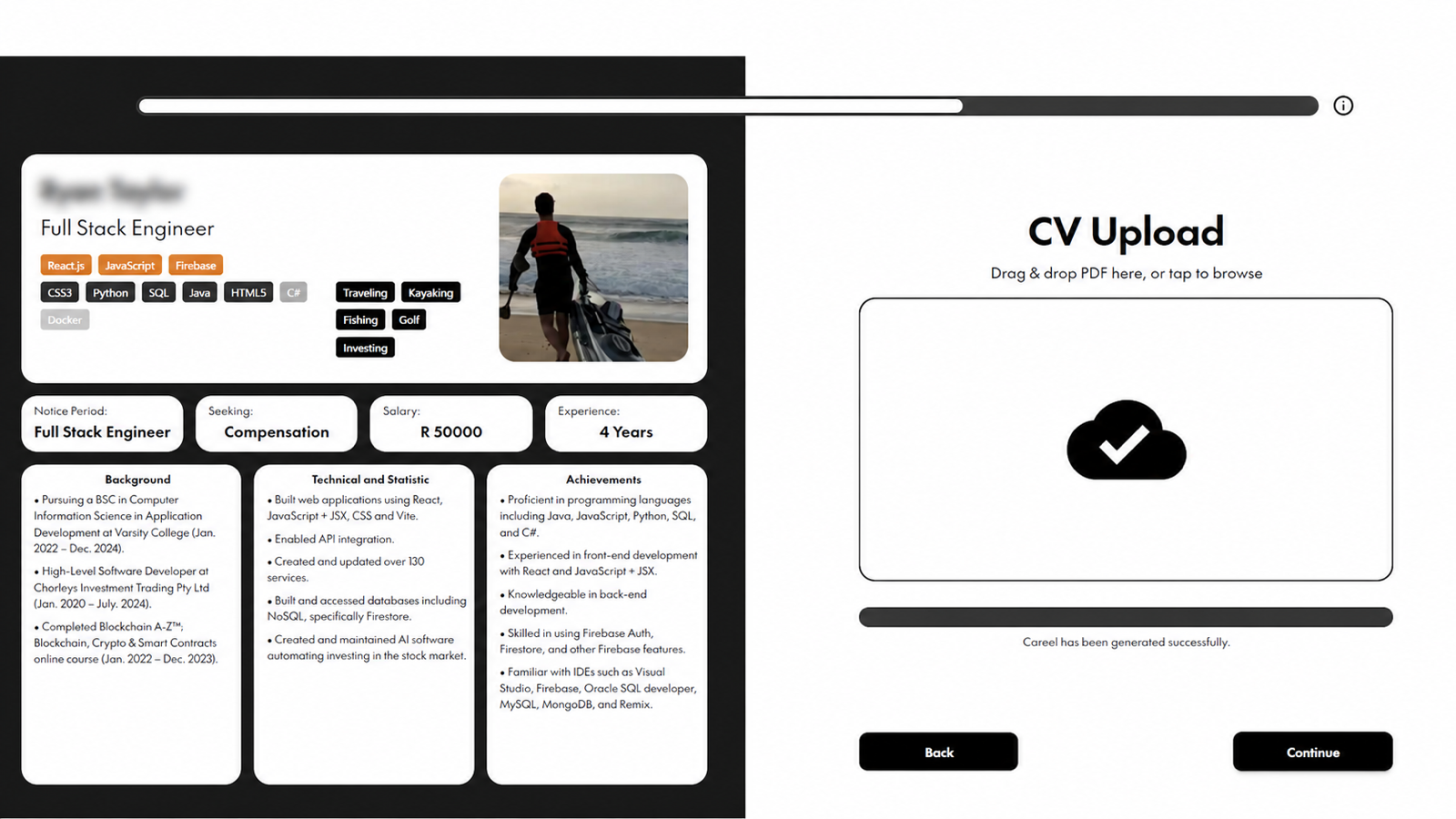
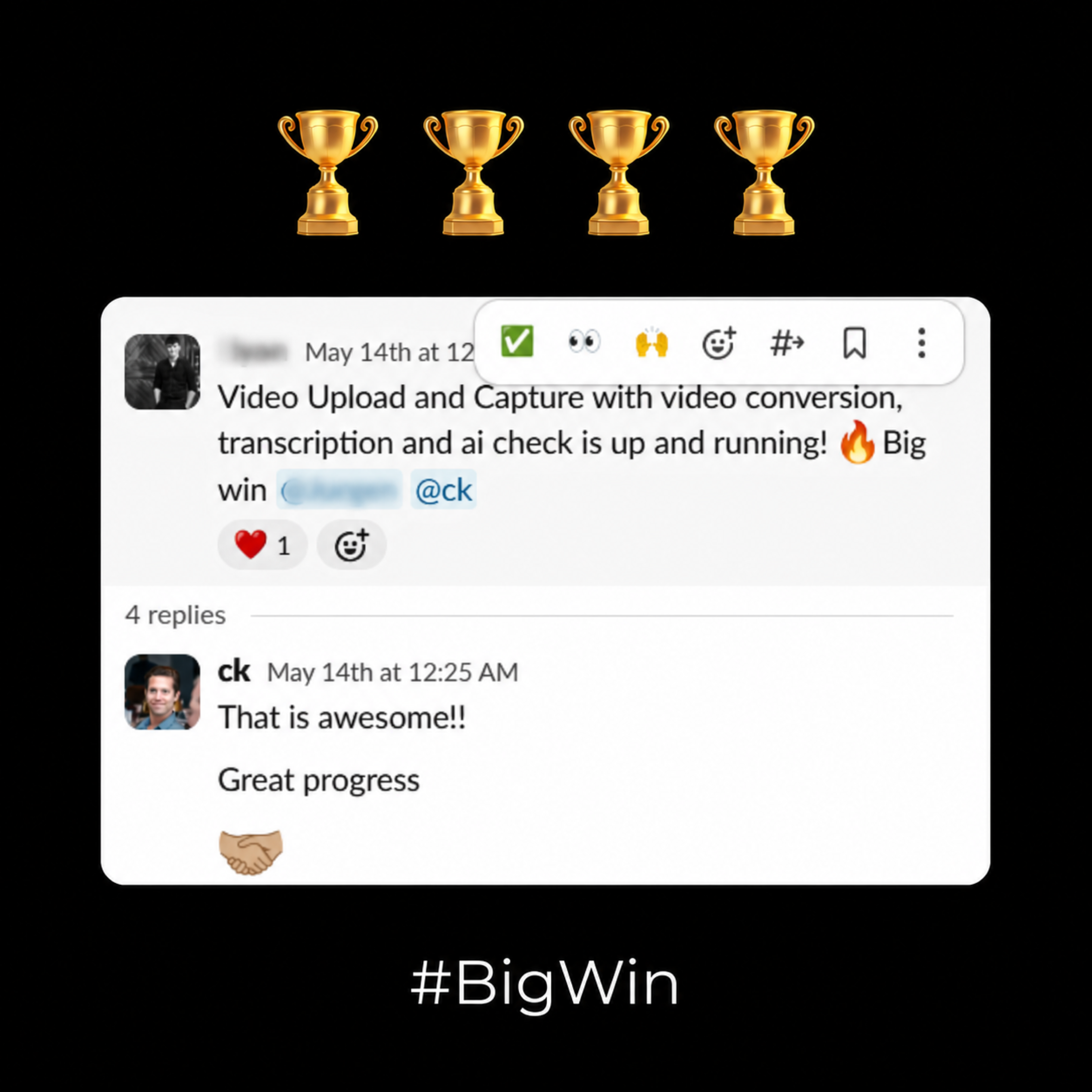
Perhaps the biggest technical achievement came mid-month: video upload, capture, conversion, transcription, and AI analysis all became fully operational.
This was a defining feature for ReelCV. Video let candidates show more than qualifications. It captured presence, communication style, and personality. AI-driven transcription and analysis turned that material into structured, searchable data. We knew we had a real breakthrough.
With the basics in place, attention turned to enhancing depth and usability:
By the end of May, Ryan walked us through V2. The platform had moved far beyond its early wireframes. We now had a coherent candidate journey from signup and video to CV upload, recruiter search, and ratings.
With so many core features working, we started internal signup testing. Members of the Hirexe team created profiles, uploaded CVs, recorded videos, and stepped into the shoes of future users. We shared feedback openly in Slack through quick videos and notes. Those test runs exposed pain points, validated design decisions, and gave us confidence that ReelCV was ready for wider trials.
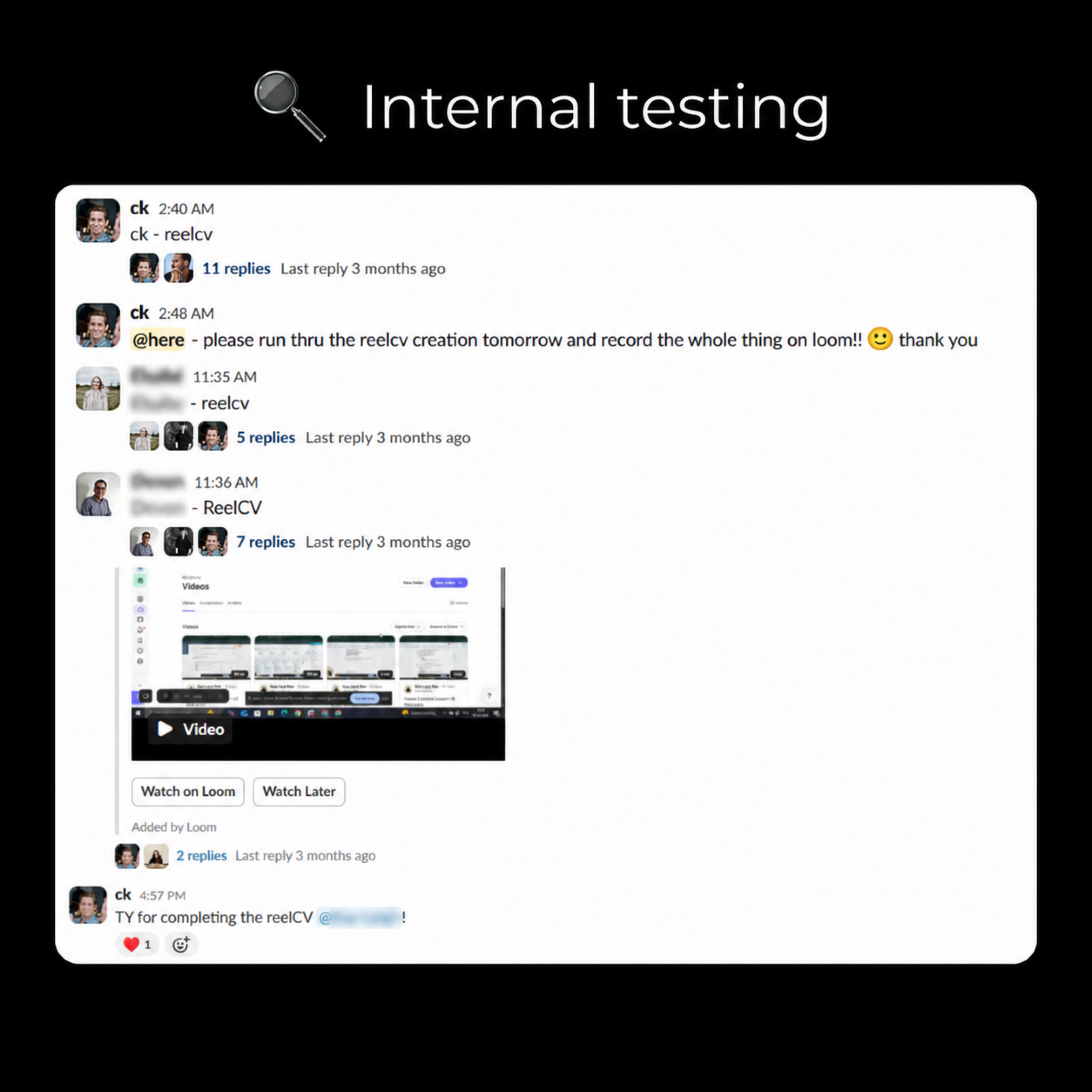
May was when ReelCV truly came to life. Scattered features matured into a working product that we could test and celebrate. For the first time, we could see the product we had been building toward for months, not just imagine it.
By June, ReelCV was no longer just an internal build. We were testing it in real-world conditions. That meant progress, but it also exposed the inevitable roadblocks that appear when theory meets practice.
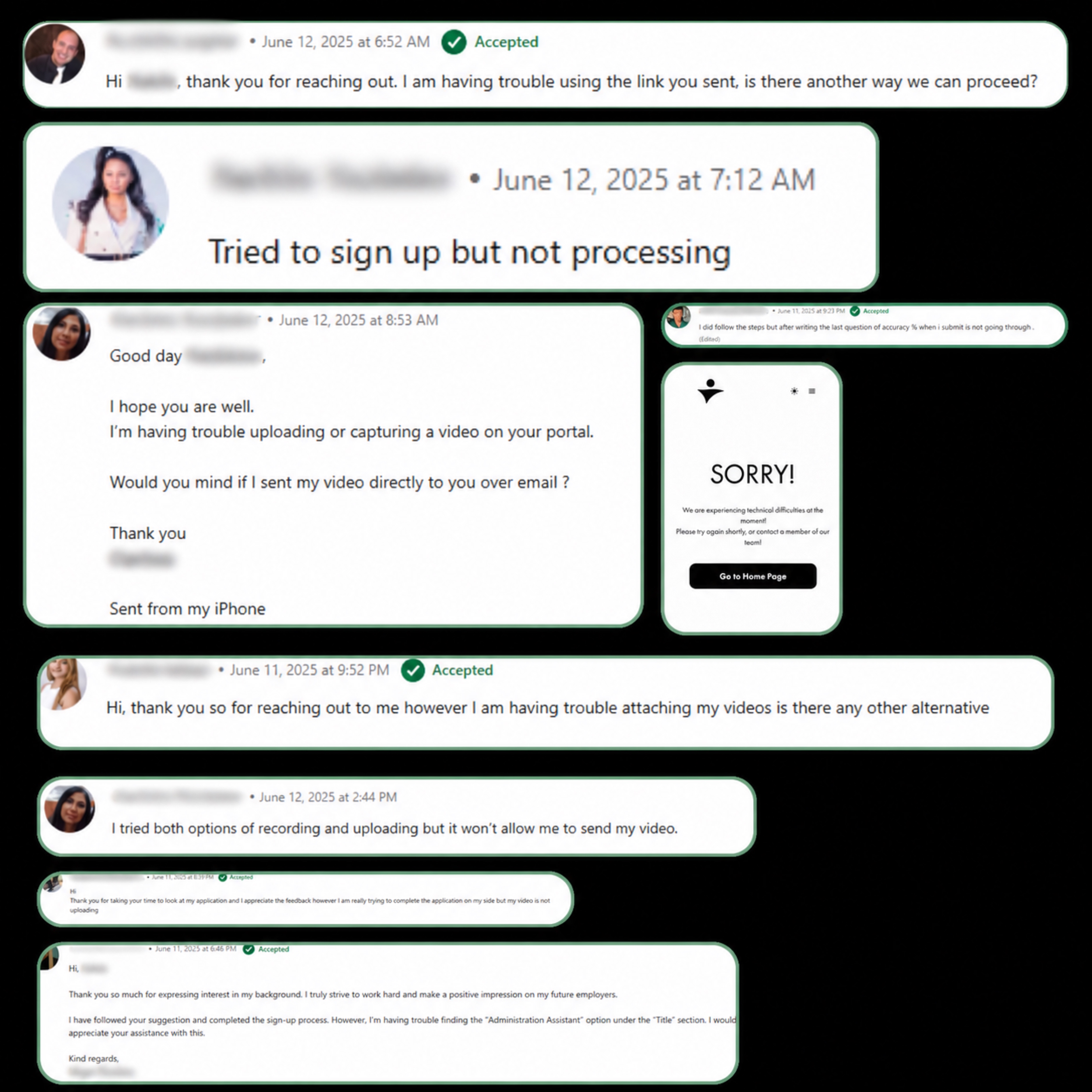
On June 12, we found a critical issue: the system was not accepting videos reliably. Because video sat at the center of ReelCV’s value proposition, we treated it as urgent and started working through fixes. It was a reminder that even the features we celebrated in May needed to hold up under real usage.
June also brought the first wave of external applicant feedback. A handful of candidates tried the new signup process, and Ryan and Nakita captured their reactions through screenshots, notes, and direct comments in Slack. Not every reaction was glowing, but the feedback was invaluable. It validated what worked and showed us what still needed improvement.
On June 20, Ryan demoed an early version of search. Recruiters could filter candidates by a mix of job title, skills, experience, and traits. It was our first real glimpse of how ReelCV could help MSPs move beyond keyword matching toward more holistic talent discovery.
We closed the month with another technical hurdle. On June 30, we hit a Google Console error that disrupted parts of the platform. It was frustrating, but it became another example of ReelCV’s resilience in progress. We tackled the issue quickly and rolled the fixes into later updates.
June was about stress-testing. The product was in users’ hands, we were watching real reactions, and the weak points were becoming obvious. Video upload and Google integration created setbacks, but we also gained authentic feedback, working search, and proof that ReelCV could handle the messy reality of live use.
July was about stability, refinement, and incremental wins. People were using the product more consistently, which kept exposing friction. We responded with targeted improvements.
We started the month with persistent Google Console issues that limited production capacity. We worked through quotas and production limits so new signups and CV uploads could continue without interruption.
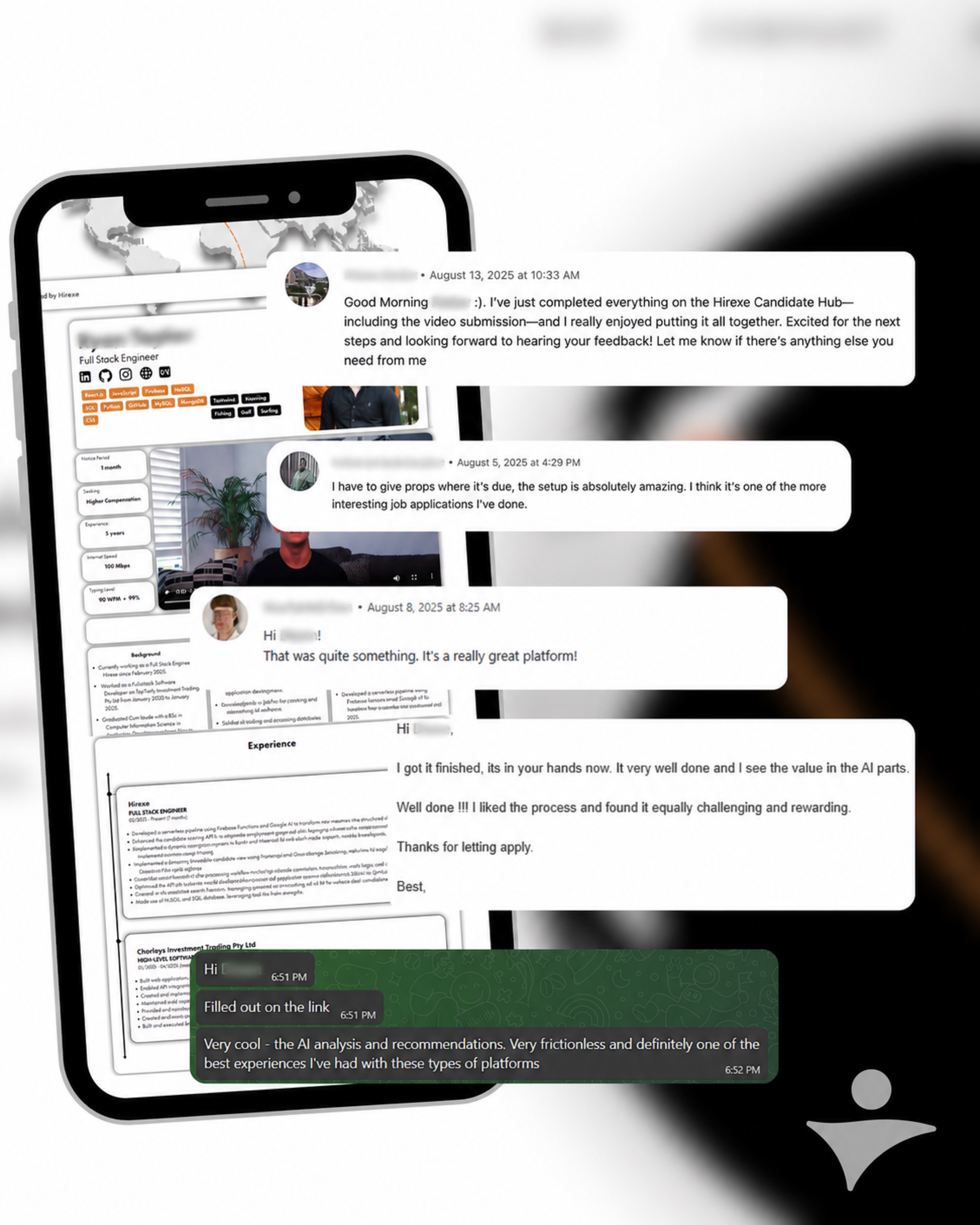
We ran product reviews on July 15, 22, and 28. Despite the technical issues, the results were encouraging. Feedback showed that usability and the overall experience were improving, validating the stabilization work we had done.
A key focus for July was deploying solutions to recurring issues from prior months:
July was a month of resilience and refinement. Google Console limitations persisted, but better monitoring, retry logic, and thoughtful feature updates kept people building ReelCVs without major disruption. Positive product reviews validated the work and showed us that ReelCV was becoming stable and dependable for both candidates and MSPs.
August marked the official launch of ReelCV. We finalized workflows, tightened the user experience, and made sure the core features worked for both candidates and companies.
By launch, we had refined onboarding, tightened registration and company creation, and rebuilt candidate search around a two-panel layout with server-side filters, sortable tables, and editable recruiter ratings. We also strengthened Firebase authentication, migrated company data, improved admin security, and completed the SQL-backend integration.
We tested the platform internally, monitored signups, and captured feedback in Slack. We reviewed errors and edge cases quickly so the product was stable for public use. Positive reviews confirmed that the overall experience had improved.
ReelCV became the clearest real-world example of something I talk about constantly: crawl, walk, run, fly. We crawled with a rough AI-assisted mockup. We walked with a working V1. We ran by putting it in front of actual users and fixing what broke. By August, it felt like we were finally flying. It was the realest culmination of that philosophy I had ever experienced. Nothing happened in one brilliant leap. It came from six months of small decisions, broken uploads, honest feedback, and relentless iteration.

ReelCV was the foundation for the AI-powered search and matching experience we now use inside Hirexe.
Here are the key aspects to keep in mind when you are applying for an entry level sales role. This advice is for someone young in their career (a couple years out of college) and actively interviewing for an entry level sales role.
Sales roles have the same fundamentals, regardless of the industry you’re in.
Sales leadership is looking for a bunch of core principles (especially when younger in career/lacking a bunch of experience).
Here is advice and what people are looking for/what to highlight when you’re interviewing for sales positions.
Everything else can be taught.
For the interview itself, come prepared with the following stories.
Building a business is constantly about making small changes.
You have to focus on the big stuff, and then let the little stuff fall into place
This is especially true at startups, and especially true with software.
Take Loom as an Example:

They started off as a user testing marketplace.
Initially, they were selling the feedback from experts. But theirs users didn't care about 'expert' feedback.
They cared about REAL feedback from REAL users that were using their product!
Now, Loom would not have been able to make this pivot if:
Quick pivot, and BOOM, Product Market Fit.
Naval nailed this is a tweet from a few years ago i haven't forgotten since.

The faster you get to 10,000 iterations, the faster you have an outlier product.
The faster you get to 10,000 iterations, the better.
Necessities for productive iteration:
Action Items:


